
Introduction. Lupin (family Fabaceae) is cultivated for human nutrition because of their high protein and oil contents. Moreover, lupin is a promising candidate to be used for phytoremediation. In Europe, three species of lupin are commonly cultivated: Lupinus angustifolius, L. albus and L. luteus. Nowadays, the European agricultural focus is upon Lupinus angustifolius, the narrow-leafed lupin, due to its advantages compared to other lupin species: the highest resistance to anthracnose (fungal disease caused by Colletotrichum gloeosporioides), high yield and short vegetation period [1]. Plant primary and secondary metabolites are diverse group of molecules that are involved in biochemical pathways, cell growth and reproduction, adaptation of plants to their environment. Interest in plant secondary metabolites has risen dramatically in recent years of their diverse effects, include antioxidant, antiviral, antibacterial and anticancer effects. The goal of the research was to optimize the growth of lupins in vitro, using plant biotechnological methods and to determine primary and secondary metabolites.
Materials and methods. This research was carried out at Kaunas University of Technology, Faculty of Chemical Technology, Department of Organic Chemistry, at Biotechnology laboratory. In this research annual lupins and hybrid lupins varieties were explored: VB Vilniai, VB Derliai, Trakiai, Hybrid number 1772 (Deter), which were derived in Lithuania (Voke Branch of Lithuanian Research Center for Agriculture and Forestry, Vilnius). Protein content was explored by the Bradford method [2]. Flavonoids were determined by spectrophotometry [3].
Results. The amount of protein in lupins, which were grown in MS media in vitro. The results showed that the highest protein content was determined in lupins Trakiai, which were grown in MS medium – 18.53 % and the lowest in Hybrid lupins - 4.86 %. Their amount was 3.8 times higher in Trakiai in comparison with hybrid lupins.
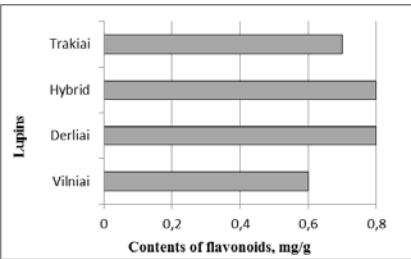
The amount of flavonoids in lupins in vitro. The results showed (Fig. 1.), that the highest flavonoid content was determined in Hybrid and lupins Derliai cultivated on MS medium in vitro - 0.8 mg/g, and the lowest in lupins Vilniai - 0.6 mg/g.
Conclusions
1. It was established that the highest protein content was determined in lupins Trakiai, which were grown in vitro in MS medium – 32%.
2. It was found that the highest amount of flavonoids was in Hybrid and Derliai lupins in vitro - 0.8 mg/g.