
Early diagnosis of dental and bone diseases is a challenge in medicine as visible changes in the hard tissues only appear when the disease is already advanced. The aim of the present work was is to investigate how chemical composition and structure of human teeth depends on the dental surface, dental disease and human age. Dental enamel, dentine and cementum are biological composites made of mineral phase (apatite), organic phase, and fluid in various portions [1].
Raman spectroscopy is a method widely used for determination of chemical composition and structure of various materials [2]. In this work, Fourier transform (FT) Raman spectroscopy with near-infrared (1064 nm) excitation which allows avoiding fluorescence background in biological samples is used for the chemical analysis of the human teeth.
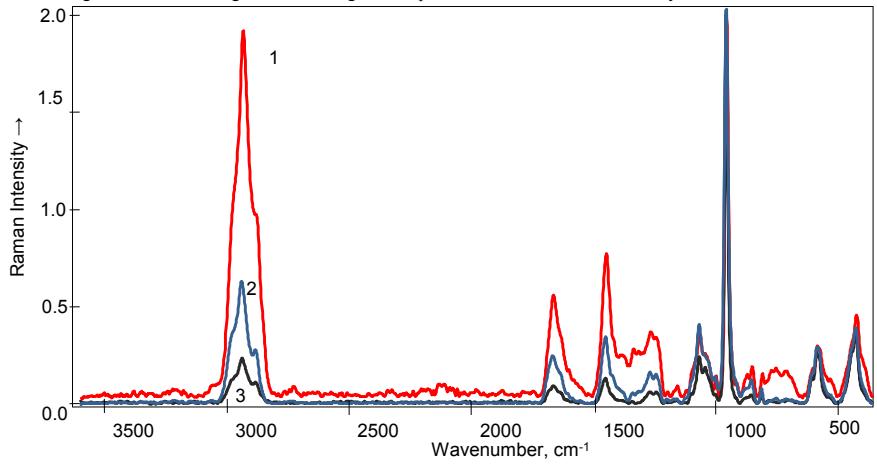
Raman spectra of different areas in the tooth are presented in Figure 1. The spectra are recorded in the area of dental caries, periodontal ligament and enamel and are normalized according to the hydroxyapatite spectral band at 961 cm-1 (νPO4). It can be seen from the graph that the amount of organic compounds, mainly represented by spectral bands at 2941 cm-1 (νCH) and 1667 cm-1 (Amide I), vary according to the dental area the spectrum was recorded at. It can be concluded that the spectral differences can be used for analysis of teeth condition; however, further and more thorough investigation is required.