Lately, there has been much interest in self-assembling InAs/InGaAs quantum dots (QDs) as active region of QD infrared photodetectors (QDIPs) [1]. This dots-in-a-well (DWELL) design allows a control of peak wavelength by changing parameters of the embedding InGaAs/GaAs quantum well (QW), and/or by adding an external electric field. However, deeper knowledge about electronic and optical properties is important for the development of QDIP devices.
This work presents a detail spectroscopic study of InAs/InGaAs/GaAs/AlAs DWELL structures grown by molecular beam epitaxy on a semi-insulating (100) GaAs substrate. Photoreflectance (PR) and photoluminescence (PL) techniques were used to explore QD- and QW-related optical interband transitions at temperatures from 3 to 300 K. Also, contactless electroreflectance (CER) and phototransmittance (PT) measurements at room temperature were performed for comparison.
Cumulative analysis of PR, PT, CER and PT in the reflection geometry revealed the influence of back-surface reflections on the PR line shape. The PR spectrum of DWELL sample with a specular GaAs substrate is actually a superposition of two components. The first component is related to photomodulated reflection from the QDs ensemble and the second one is associated with reflection from GaAs substrate. The second component is dominant and occurs due the photoabsorption (PA) effect. In order to eliminate PA in PR spectra substrate of the sample was sanded.
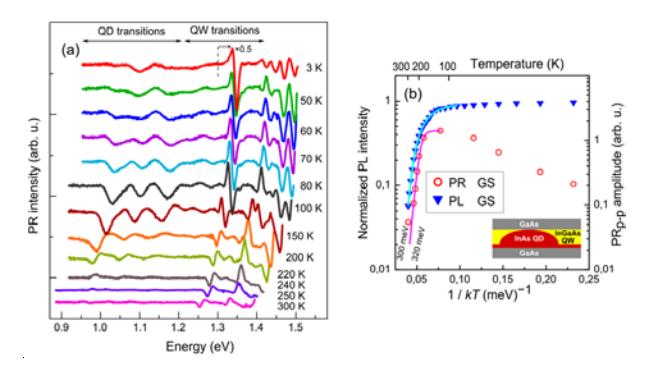
Temperature-dependent (3–300 K) PR spectra revealed a variety of optical transitions related to InAs QDs and binary QWs, formed by InAs wetting and InGaAs cap layers (Fig. 1a). The interband transition energies of ground- and even four exited- states for InAs QD were established. That indicates a high uniformity of QDs ensemble. Also, it was suggested that temperature-dependent lineshape in PR spectra varies with photomodulation mechanism. More detailed analysis of PR spectra disclosed that at high temperatures the line shape is influenced by the quantum-confined Stark effect. Whereas at low temperatures the line shape of PR indicated a presence of state-filling mechanisms.
Intensity and energy of InAs QD optical transitions were studied in more detail varying the temperature. PR amplitude and PL intensity of QD GS transitions (Fig. 1b) is almost identical at high temperatures. This thermal signal quenching was analyzed using Arrhenius-type expression:
$$I = \frac{I_o}{1+ a \exp(E_q/kT)} \tag{1}$$In the high temperature region, the activation energy $E_q \approx 320$ meV derived from Eq. (1) implies that a decrease of PR signal intensity is related to the excitons escaping from the QD bound-state to binary QW. Also, we observed that temperature dependence of QD-related optical transition energies follows the Varshni relation with parameters, which are between that of a bulk GaAs and InAs [2]. This indicates that the QD composition is partially changed due to Ga/In interdiffusion during the epitaxial growth.