
Ionic liquids (IL) used as new solvents and industrial materials have been widely investigated because they have some specific properties such as high ionic conductivity, nonvolatility, and high viscosity. Researchers have been trying to understand the relationship between the properties and the anion-cation structure from the viewpoint of molecular science.
Infrared (IR) absorption vibrational spectra provide important information to determine molecular structures. However, vibrational spectra of ionic liquids are not easy to be measured. Liquid phase spectra present broad bands which are hiding important spectral information. Gas spectra are difficult to measure because vapor pressures are not high enough to obtain sufficient quality vibrational spectra [1]. These problems could be solved by using a low-temperature matrix-isolation method. The essence of the method is to trap molecules under study in low temperature (usually below 10 K) rare gas crystals.
During this study we succeeded to evaporate ionic liquid without thermal decomposition and measure IR absorption spectra (fig. 1).
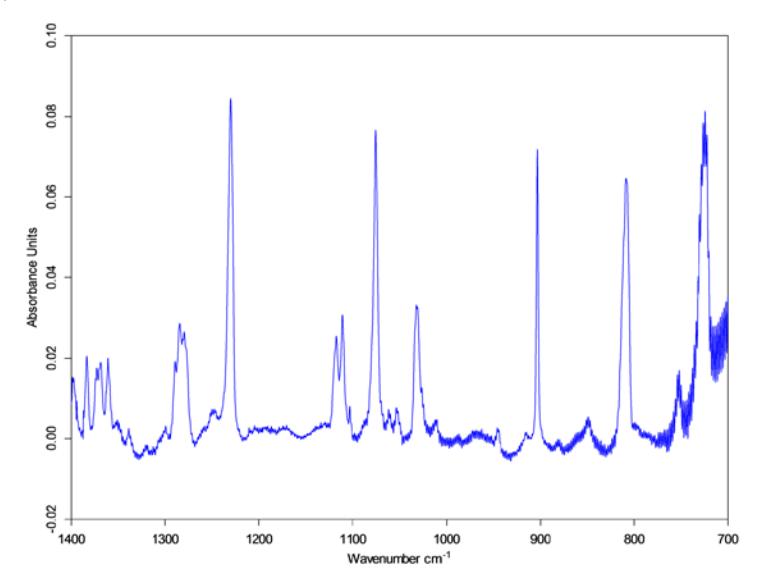
Sharp bands of the infrared absorption spectra with the aid of theoretical calculations allow precise assignment of each band to the vibrations of the atoms in the ionic liquid. Spectral and calculated data allows us to state that ionic liquid evaporates in pairs and not in individual ions. The annealing experiments exhibit changes in the infrared spectra, indicating possibility of conformational changes or complex formation.