
The main aim of this study was estimation - how water reuse can save energy provided for water supply at students dormitories. The research was carried out by exchange students studying at Vilnius Gediminas Technical University (Lithuania). The quantity of the water reuse was measured as follows: daily (L/d) and weekly L per 7 days. The energy quantity for water supply was calculated and estimated using installed water pump technical characteristics.
Water reuse is one of the key strategies of Green University recycling system in Lithuania. Water reuse can help realize that energy-efficient and sustainable equipment is required at students dormitories and class-rooms. At present, reusability of water and energy is determined only by the materials functional situation or the economic cost evaluation analysis. It does not cover all triangle of sustainability, including environmental, economic and social point of views. In this study, the sustainable integrated method, hands-on possibilities assessment, is employed to measure reusability of water and energy saving. The references [1 and 2] were used for the comparison research needs. Water reuse experience at other contries was usefull when all measurements and statistical calculations were carried out.
Measured and statistically evaluated results of possible water reuse at students' dormitory (presented in Fig. 1), were found to be different following all students activities evaluated in this research. All abbreviations in the Figure 1 means: Ma-morning activities (showers, toothbrush, breakfast); Mi-midday activities (lunch); Gi-sport related activities; Sa- sauna-related activities; Ve – evening related activities (dinner); Ba - (bath).
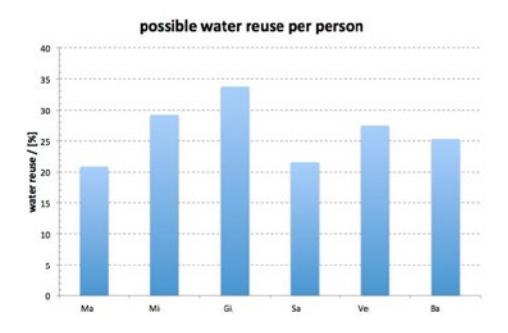
Annually approximately 1839 m3 water can be reused in case of implementing water saving devices at students dormitory. Estimated and calculated saved energy quantities supposed to be approximately 232 kWh annually per academic year. The results of case studies show that, energy saving based reusability of shower water and bath water will help improve water supply facilities at student's dormitories.