
Plant cultivation in greenhouses with artificial lighting is an important technology. Nowadays high pressure sodium, metal halide and fluorescent lamps are mostly used for this application. However, solid state lighting allows achieving higher productivity and nutritional quality due to the reason that the spectral power distribution (SPD) of LEDs can be modified and chosen to meet the physiological needs of plants. There are three main photophysiological processes in plants: phototrophy photosynthesis and photomorphogenesis that require blue (400-500 nm), red (620-680 nm) and far-red (700-760 nm) light respectively [1]. Blue and red components can be provided by a high quality InGaN and AlGaInP LEDs respectively. However, AlGaAs LEDs that emit light in a far-red spectral range, degrade fast, are sensitive to humidity and temperature variations [2]. A solution to this problem could be a phosphor converted LED (pcLED) composed of a blue InGaN LED and a far-red phosphor converter, for example Y3Ga5O12:Cr3+ (YGG:Cr) [3].
In this work, using an YGG:Cr phosphor described in ref. 3 and a blue InGaN LED a solid state lamp for greenhouse lighting was designed and its spectral properties were measured. Furthermore, the morphological: x-ray diffraction (XRD), scanning electron microscopy (SEM), and luminescent properties: diffuse reflection, photoluminescence (PL), PL excitation (PLE), and PL quantum efficiency (QE) of YGG:Cr phosphor tablets, annealed at different temperatures (1000 °C-1400 °C) were measured.
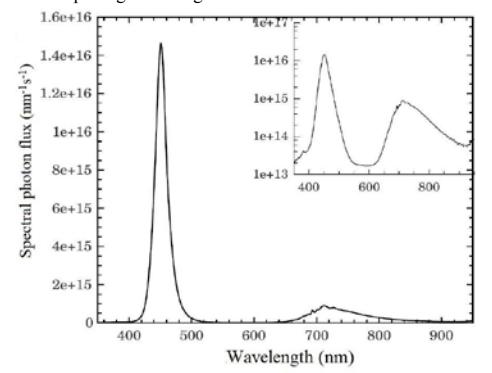
The converter of the designed far-red lamp was made of YGG phosphor powder doped with 8 mol% Cr3+ and annealed at 1300 °C temperature and transparent silicone. The composition of the converter and the spectral properties of the lamp are given in table 1. The SPD of the pcLED is given in Fig. 1. The designed far-red lamp prototype was transferred to "Institute of Horticulture Lithuanian Research Centre for Agriculture and Forestry" for further research on the plant growth in greenhouses.
| Photon flux (I = 350 mA) | |
|---|---|
| Concentration of YGG:Cr powder in the silicone converter | 5.7 wt% |
| Blue LED without lens | 2.2489 µmol/s |
| Blue LED with lens | 2.2074 µmol/s |
| Blue LED covered with a converter | 0.6361 µmol/s |
| Phosphor PL | 0.1367 µmol/s |
| The Sum of blue LED and phosphor PL in the lamp | 0.7728 µmol/s |
| Converter efficiency | 35% |
The XRD spectra of tablets confirmed that the structure of YGG:Cr is garnet. SEM images clearly show that higher annealing temperatures increase the uniformity of the samples. Moreover, it is observed that for higher annealing temperatures a crystal structure of phosphor particles are more pronounced. The measurements of the diffuse reflection showed absorption in the regions of 400-520 nm and 580-680 nm, which matched well with the PLE spectra that peaked around 420 nm and 600 nm. The PL spectra of the tablets showed a broad band in a far-red region that peaked around 700 nm. The measurements of QE showed that pressing YGG:Cr phosphor powder to tablets can significantly increase the efficiency of phosphors. The highest obtained value of QE was 55% for YGG phosphor tablet doped with 8 mol% Cr and annealed at 1300 °C temperature.