Analysis of the composition of drinking water is actual problem. Bromates are contaminants that develop in drinking water mainly as the disinfection byproducts [1].The bromate ion BrO3- may exist in a number of salts, the most common of which are potassium bromate KBrO3 and sodium bromate NaBrO3.
This work shows the surface-enhanced Raman scattering for potassium bromate (KBrO3) with two types of substrates. The substrates have been prepared by gold nanoparticles immobilizing on the glass surface via layer-by-layer electrostatic deposition during 1 hour and 24 hours. The monodisperse gold sol have been prepared by Turkevich technique [2]. Optical density spectrum of the gold sol shown the maximum on 532 nm. The average size of nanoparticles was about 12 nm.
The potassium bromate water solutions have been deposited on the SERS-active substrates and dried at the room temperature in the horizontal position. Concentration of the solutions was 10-1 M. The solutions in the same manner were also deposited on the reference metal-free substrates.
The YAG:Nd3+ laser (532 nm) was used to excite the Raman spectra. Registration spectrum occurred range 200-1000 cm-1. The registration system consisted of a spectrograph (Spectra Pro-500i, Acton, USA) with a diffraction grating 600 lines/mm and a CCD matrix. For Raman measurements exposure time was 75 s.
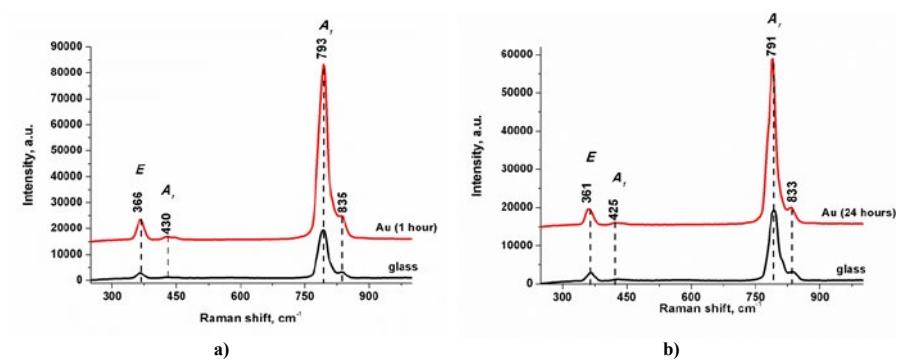
Raman spectra for the potassium bromate on the glass surface and the gold substrates are shown in (Fig. 1). We can see asymmetric band E at 366 cm-1, symmetric band A1 at 430 cm-1, symmetric stretching A1 at 793 cm-1 and band at 835 cm-1 [3, 4]. The bands at 366, 430 and 793 cm-1 correspond to vibrations of bromate anion (BrO3-) [3].
In both cases the enhancement of the bands corresponds to 366, 793 and 833 cm-1. The enhancement of the bands for the gold substrate (1 hour) is 2.8-3.5 times (Fig. 1a) and for the gold substrate (24 hours) is 1.5-2.3 times (Fig. 1b). The maximum gain in both cases is for the band 793 cm-1: 3.5 for the gold substrate (1 hour) and 2.3 for the gold substrate (24 hours).