The properties of ionic liquids (ILs) have attracted much attention from both theoretical and practical viewpoints for a long time. These liquids, being great solvents, are interesting media for vibrational relaxation study. In this work, acetonitrile (AN) molecule was used as a probe in ILs to carry out the AN C≡N stretch (also known as $v_{2}$) vibrational relaxation investigation.
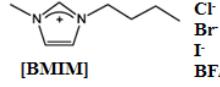
A few different imidazolium based ILs (namely 1-butyl-3-methylimidazolium bromide ([BMIM]Br), 1-butyl-3-methylimidazolium iodide ([BMIM]I), 1-butyl-3-methylimidazolium chloride ([BMIM]Cl)), 1-butyl-3-methylimidazolium tetrafluoroborate ([BMIM]BF4)) (see Fig. 1) were chosen to enable the study of vibrational relaxation dependence on anion molar mass. Furthermore, different temperatures (295K and 328K) were used to determine AN C≡N stretch vibrational relaxation dependence on temperature. The structure of $v^{2}$ band was analyzed using two-dimensional correlation analysis.
From the carried out experiments it was found that acetonitrile vibrational relaxation is faster in studied ILs solutions (from 2,14 ps in neat AN to 1,27 ps in AN/[BMIM]I 20% AN wt solution) and increased temperature of these solutions lead to even faster relaxation (from 1,31 ps at $T$ = 295 K to 1,26 ps at $T$ = 328K in AN/[BMIM]Br solution).
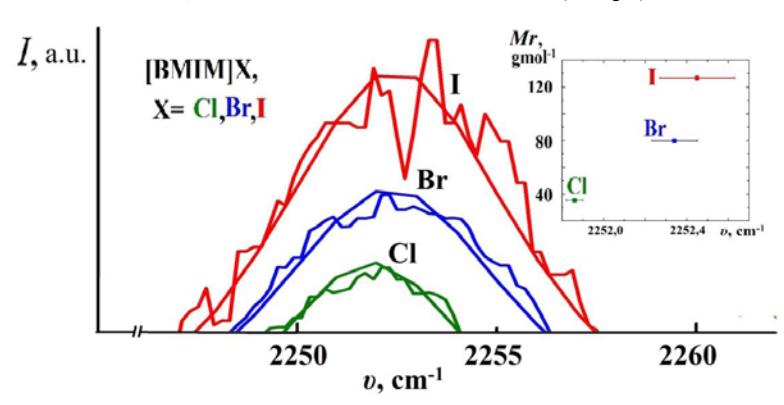
Decreased acetonitrile vibrational relaxation time (from 1,4 ps to 1,27 ps) when anion (of IL) was replaced by a heavier one (in this case heavier halogen) could be attributed to the change in local ionic structuring [1]. It also seems that the heavier the anion of the IL, the more red shifted C ≡ N stretch band became (see Fig. 2).