
Nephorolithiasis more and more becomes a worldwide health problem. Its prevalence varies from 1 % to 20 %. After treatment, kidney stones tend to recur and the probability of the recurrence is about 75 % during 20 years [1]. For the planning therapy and in order to avoid the recurrence it is important to know the chemical composition of the kidney stones.
In this work, kidney stones were analyzed by far – infrared (FIR) spectroscopy method, which has never been used before. The aim of the work was to get additional information about the stones' composition to the one that can be obtained with traditionally used physical methods. In order to record FIR absorption spectra, the samples must be prepared by polyethylene (PE) pellet technique. The grained stone is mixed with the PE powder and the mixture is pressed into a pellet under heating. Spectra of the samples were taken using VERTEX 70 (Bruker) spectrometer equipped with wide-range beamsplitter and DTGS detector. The spectral range was between 680 and 30 cm-1.
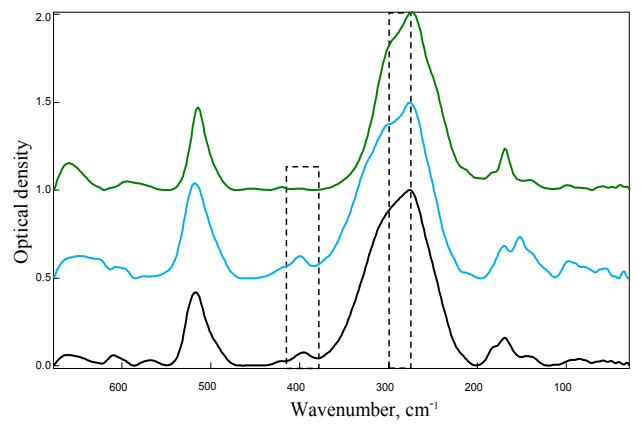
Normalized spectrum of a kidney stone constituted from calcium oxalate monohydrate and calcium oxalate dihydrate and corresponding spectra of the pure components are presented in figure 1. It can be seen from the spectra that the oxalates can be distinguished from one another by a marker band at 395 cm-1. Other types of stones (apatite, struvite, uric acid, brushite and their mixtures) have been analyzed as well. Comparing the results with the ones obtained earlier by means of middle-infrared spectroscopy it was determined that measurements in the FIR spectral range not only allows finding out chemical composition of the kidney stones but also complements the results of mid– infrared spectroscopy method - it becomes possible to unambiguously identify calcium oxalate dihydrate. In conclusion, FIR method is suitable to investigate the kidney stones, however, a more detailed analysis and a broader spectral library is required for the method to be used conventionally.