
Single dopant impurities in semiconductors under control of electric and magnetic fields are among the most promising physical systems for implementing a quantum computer [1]. This problem has stimulated much theoretical studies and numerical simulations on the quantum states of donors localized near a semiconductor surface in a magnetic field [2-4]. However, in previous works the system has been considered without external electric field [2-3] or under uniform electric field [4]. In the given work, we additionally assume a disc-shaped gate as a source of the external electric filed, and study characteristics of electron shuttling from the donor to the gate in the presence of uniform magnetic field.
We consider the donor near semiconductor surface, at which the disc-shaped gate is situated. Two kinds of boundary conditions for the field applied by the gate are used. Firstly, we consider that the gate is surrounded by a dielectric material. Secondly, we assume that the gate is surrounded by a metal, at which the potential equals zero. Magnetic field is applied perpendicular to the semiconductor surface. Then, the stationary Schrödinger equation for the impurity electron in cylindrical coordinates is given by
$$ \hat{H}\Psi = E\Psi \tag{1} $$with the Hamiltonian operator
$$ \hat{H} = -\frac{1}{\rho} \frac{\partial}{\partial \rho} \left( \rho \frac{\partial}{\partial \rho} \right) - \frac{\partial^2}{\partial z^2} - \frac{1}{\rho^2} \frac{\partial^2}{\partial \phi^2} - i\mu \frac{\partial}{\partial \phi} + \frac{\mu^2 \rho^2}{4} + V_D + V_{D'} + V_{im} + V_G \tag{2} $$where $\mu$ is considered as a measure of the magnetic field strength, VD, VD', Vim are the interactions between the electron and the donor, the donor image and electron image respectively, VG describes the potential landscape in the semiconductor due to the gate. The problem for the equation (1) – (2) has been solved using finite element method (FEM).
We have investigated the effect of magnetic field on the structure of electron energy spectrum of near-gate states, i.e. when the donor is infinitely distant from the semiconductor interface (Fig. 1). The system in this case can be considered as a quantum dot induced by electric field. On the basis of FEM results, we also propose a trial function of a simple form for variational method to take into account magnetic field effect for near-gate states. The energy spectrum of near-gate states is compared with energy spectrum of near-donor states (Fig. 1).
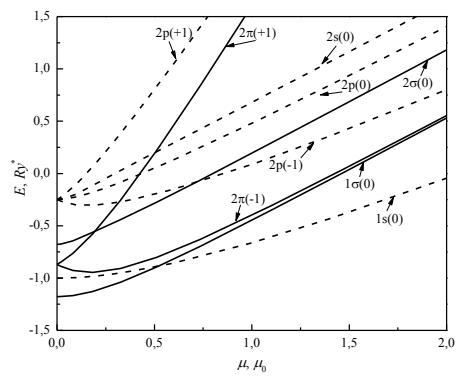
Two main characteristics of electron shuttling from the donor to the gate have been studied: critical gate potential at which the shuttling takes place and minimum gap (gmin) between ground and first excited $\sigma$-state, which can be used to estimate the tunneling time. It has been found that the presence of magnetic field leads to increasing of the critical potential. The dependence of gmin on $\mu$ has been found to reveal nonmonotonic behavior: the value of gmin increases on ~20% for $\mu$ < 0.2 and decreases for larger magnetic fields.
Differences between the cases of uniform and nonuniform external electric fields have been studied.
We have also studied the effect of image charges, gate diameter, donor position on donor states in electric and magnetic fields.