Photovoltaics is a promising large scale technology for the electrical power generation. However, the cost should be reduced to make it competitive with fossil fuel technologies. On one hand, there is a great interest in developing nanomaterial transparent conductive electrodes to replace conventional indium tin oxide films, in order to enable low-cost and mechanical flexibility while maintaining low sheet resistance and high transmittance [1]. On the other hand, the cost of photovoltaics could be reduced using thin film technology. A great limitation in all thin film solar cell technologies is that the absorbance of near-bandgap light is small, in particular for the indirect-bandgap semiconductor Si, and conventional pyramid surface structuring is not suitable for thin film solar cells. The use of metallic nanostructures that support surface plasmons is a promising method for achieving light trapping in thin film solar cells [2].
Silica sol-gel process is a versatile method allowing precise control of the structure. This method became widespread because of its simplicity and ability to change properties of the structure by embedding additional substances during the process. In sol-gel process silica is synthesized using monomer alkoxide precursor tetraethyl orthosilicate in a solution during polycondensation reactions. After the synthesis of silica sol, a thin film of sol is coated on glass plate by spin coating method followed by drying in a furnace.
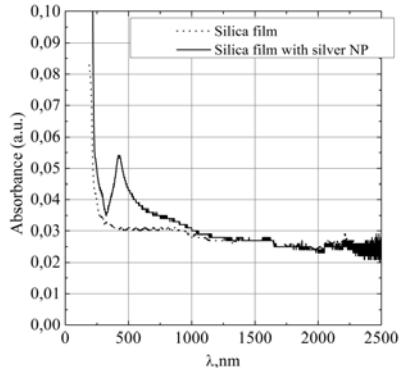
This work focuses on modification of silica thin films by embedding silver nanoparticles (NP). For the preparation of silver NP, reduction of silver ions in a solution was used. Two approaches of NP embedding into silica were used: (i) addition of NP to the silica sol and (ii) addition of silver ions to the silica sol and reduction during film drying. To prevent growth of silver NP and to increase stability a polymer stabilizer was added. The formation of silver NP was confirmed by color change of silica films, atomic force microscopy and UV-VIS-NIR spectrophotometry. Absorbance spectra of silica film without (dotted line) and with (solid line) embedded silver NPs spin coated on fused silica wafer are shown in Fig. 1. The peak centered at 424 nm is due to the localized surface plasmon resonance in silver NP.