The generation of higher energy radiation from exciting radiation of lower energy is called up-conversion. This phenomenon describes the transition of the radiation of low energy to a higher energy radiation by multiphoton absorption and subsequent luminescence.
Up-converting nanoparticles have many applications but our main goal is a synthesis of nanoparticles that can be used in fluorescent imaging. Typically to excite fluorophores UV light is used but UV light has plenty of disadvantages (especially to living organisms) which will be listed in the poster. But by using up-converting nanoparticles we can prevent potential damages to organisms since the nanoparticles are excited with near-infrared radiation[1]. There is also hypothesis concerning biofunctionalization of these nanoparticles to use them in treatment e.g. of cancer but it is not exactly our research goal.
In this poster we focus on synthesis of nanoparticles emitting visible light from infrared radiation in two-photon absorption. We used Gd2O3 as a matrix doped with rare earth elements: Yb and Er. We synthesized them by simple precipitation method. We investigated how time and addition of Mo atoms affect fluorescence intensity and emission spectrum.
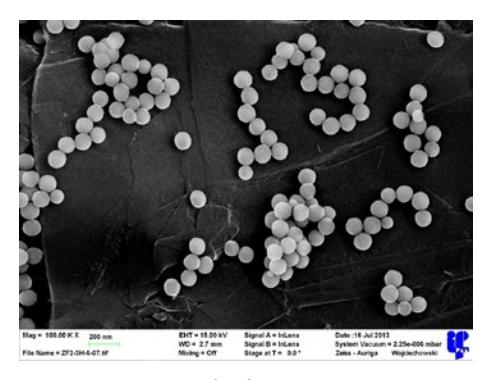
Structure and size of nanoparticles were also determined. These measurements were taken on scanning electron microscope (SEM). Exemplary photo below: