High energy physics studies strongly interacting matter at extreme temperatures and densities. The Large Hadron Collider, at CERN, is the particle accelerator with the highest energy per nucleon presently available.
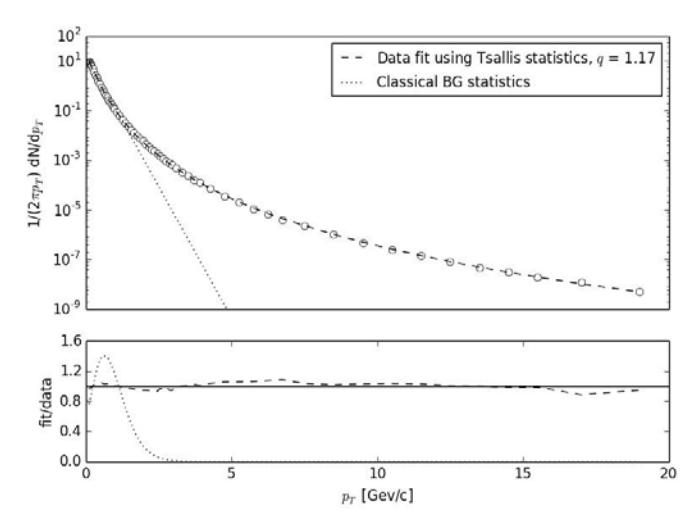
The transverse momentum spectra of hadrons produced in collisions involving protons and also heavy ions at RHIC and LHC energies have recently been successfully investigated through nonextensive statistical mechanics. Nonextensive statistics is recently introduced generalization of Boltzmann-Gibbs statistics. Four decades ago a statistical-mechanical approach to analytically describe transverse momentum spectra was already used. It was done using Boltzmann-Gibbs statistics. This classical approach works well at low beam-energies. However, the experiments at higher energies have produced data that depart more and more from a standard thermal behavior, giving rise to power-law distributions in the high transverse momentum regime. These properties, as seen in Fig. 1, are well reproduced using nonextensive statistics (Eq. 1). It will be shown that nonextensive statistics reproduces transverse momentum spectra for wide energy range and different collisions i.e. p-p, Pb-Pb, p-Pb.
$$f(p_T) = A \exp_q\left(\frac{m_T}{T}\right) = A\left(1 + (q - 1)\frac{m_T}{T}\right)^{\frac{1}{1-q}}\tag{1}$$