
Fast microfabrication of metal foils is becoming essential due to the increasing industrial requirements of nano-micrometer scale high-quality devices and materials especially in the automobile, making shadow-masks for display devices from Invar alloys [1]. Conventional laser systems (nanosecond or longer pulse duration) are applicable, however, additional post-processing treatments are required to improve quality, in addition ablation in air or vacuum creates more residue around the cutting path as a portion of the material is ejected from the irradiated area [2]. By using femtosecond pulse lasers we can achieve better precision and greater quality cuts and there is no need for post-processing of the cut samples, however residue around the area is still unavoidable. By using a thin film of water above the metal the ejected material is contained in in the water and does not stick back to the material, in addition, the fabrication throughput increases dramatically. The aim of this article is to demonstrate a method for precise, efficient and high quality processing of thin metal foils.
The experiments were done using a Pharos laser (up to 20 W), pulse duration- 280 fs, repetition rate- up to 660 kHz, pulse energy- up to 400 μJ, wavelength 1030 nm. An f-theta lens (f=100mm) was used for focusing of the beam, the beam was guided using a Scanlab® galvanometric scanner. The experiments were produced when pulses were focused in air and in water. For the case of water the metal foil (0.04 mm copper) was cowered by a thin (0.5 mm) water layer [3]. An investigation was performed on how scanning speed of the beam and focal position relative to the surface of the sample influence the process (in water and air). The focal position is changed using a stepper motor stage (that translates along the z direction). The laser parameters used in the experiment were: power 5W, pulse time 280 fs, repetition rate 25 kHz. The time required to make a through cut along a 10 mm line was measured.
Our results show that cutting without water takes approximately 5 times longer to cut through the material and the quality is considerably worse compared to cutting with water. The quality is also impacted by the scanning speed (is gradually worse at low speeds). Through cuts without the water layer are produces after approximately 0.75s (for a total length of 10 mm) this corresponds to an effective 13 mm/s cutting speed. With water the cutting time equals approximately 0.15s (effective cutting speed is ~65mm/s). The differences in quality can be seen in Fig. 1.
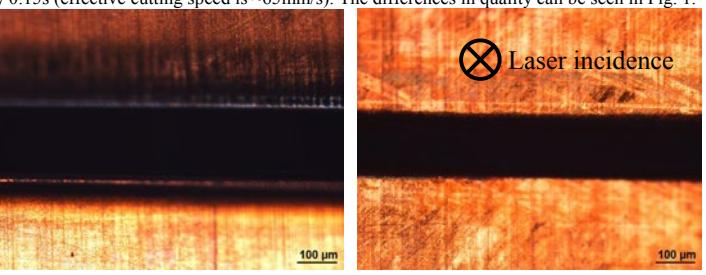
As it can be seen from Fig. 1 the use of water eliminates color change near the edges of the cut, i.e. the heat affected zone must be greatly decreased, in addition, water-ablated lines possess less or no residue, contrary to when ablation was done in air.
Further tests could lead to better quality and process speed as better parameters for processing are found. Ablation in water could be used in the micromachining of Invar alloys. The most valuable property of Invar is its very low coefficient of thermal expansion, which makes it a great resource in the making of high precision instruments like clocks, seismic creep gauges, television shadow-mask frames, valves in motors and antimagnetic watches.