Recently, the CMS collaboration reported an unexpected long-range in rapidity, near-side (“ridge-like") angular correlations in very high multiplicity proton-proton collisions, so called ridge effect [1]. This surprising observation suggests the presence of a collective flow that resembles the one believed to produce a similar correlation hydrodynamically in heavy-ion collisions.
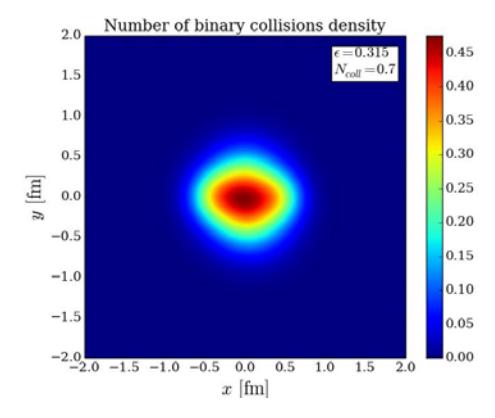
If the hydrodynamic description is valid then the effect should be triggered by the initial spatial anisotropy of the colliding matter. The estimation of this anisotropy within different models of the proton internal structure and verifying whether it leads to the agreement with the experimental data could in principle constitute a test for such models.
Inspired by [2,3] we proposed several phenomenological models of the internal structure of proton. Subsequently we calculated the expected initial eccentricity and triangularity of the dense matter formed in proton-proton collisions within the formalism of the Glauber model, commonly used in the description of heavy-ion collisions [4]. We indeed found that the initial anisotropy can account for the ridge effect, though our considerations do not lead to a very stringent test of the models.