
In the majority of an events in hadron-hadron collisions an object exchanged between the interacting protons is a quark or a gluon. Such exchange typically results in a multiparticle final state distributed over several units of rapidity. These types of interactions are not the only possibilities. An object exchanged in t-channel can be also a colour-singlet. Such a process is expected to yield events containing a rapidity gap, i.e. a region in rapidity devoid of particles. One of the best candidates for such colour singlet is the Balitsky-Fadin-Kuraev-Lipatov (BFKL) Pomeron[1].
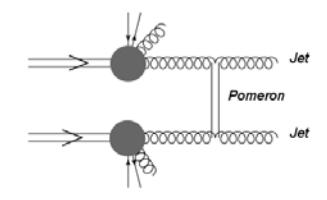
For more than 20 years a large effort has been devoted to understand the QCD dynamics of rapidity gaps in jet events when there is a rapidity gap between two high-pT jets. One can immediately realise that in such a process, due to the colour singlet exchange, no particles are produced between the leading jets. This gives a clear experimental signature.
Despite of the fact that the studies of Jet-Gap-Jet events were performed at the Tevatron[2], there is still no consensus on what the relevant QCD mechanism really is. The LHC accelerator opens a possibility to shed more light on this topic. In the presented work the theoretical description of this process as well as the predictions for the LHC experiments will be discussed.
To compute the JGJ process in the BFKL framework several issues need to be addressed. For example, the problem of coupling of the BFKL Pomeron to partons, has to be solved. This is usually done using the Mueller-Tang (MT) prescription[3]. Nevertheless, it is known that the original MT calculations did not describe the data properly[4]. In addition, one needs to take into account the soft interactions which in hadron-hadron collisions can destroy the rapidity gap as well as the next-to-leading-logarithmic (NLL) corrections which are known to be large[5]. In the presented work an additional need of using the full BFKL kernel with sum over the all so-called conformal spins will be explained.
Implementation of the BFKL formalism in the form of a Monte Carlo generator will be presented. In particular, the extension to jet transverse momentum up to 1000 GeV (available at the LHC energies) will be discussed.
Finally, the measurement of the ratio of the Jet-Gap-Jet cross section to the non-diffractive inclusive jet cross section, will be presented as a way to identify BFKL effects at high energies. During the talk the predictions of various theoretical models will be shown and the possibilities of their experimental tests will be discussed.