
Plasmon-enhanced fluorescence of molecular probes is a highly developing field providing a number of new methods in chemical and biomedical analysis. It is based on the following effects: the heightened electromagnetic fields near nanostructured metallic surfaces due to localized plasmon resonances and propagating surface plasmon polaritons enhance the excitation rate of fluorescent species placed in the near field; the close vicinity of metal nanostructures change fluorescence quantum yield drastically due to density of states effect and possible energy transfer to metal surface. So fluorescent enhancement depends on different factors, like size and shape of the metallic nanoparticles, its absorption properties, distance between them and fluorophore [1,2].
In previous works we had investigated plasmon-enhanced fluorescence of model biological conjugates BSA-FITC near silver nanoparticles deposited on glass substrates both theoretically and experimentally [3,4]. The goal of this work was to develop the fluorescent immunoassay for Alpha-Fetoprotein (AFP) that takes advantages of the plasmon-enhanced signal. For this purpose multilayer nanostructures “silver nanoparticles – polyelectrolytes – immunocomplex” were prepared by successive deposition on plastic substrates [3]. Silver sol was synthesized by the AgNO3 citrate reduction technique. Complexes AFP-anti-AFP - FITC were obtained by 1) deposition of the different concentrations of the AFP to the preliminarily prepared samples with/without silver coating; 2) deposition of the BSA to block all molecules that have not connected to substrate; 3) removal of the AFP-BSA complexes; 4) deposition of anti-AFP-FITC.
Fluorescence spectra were registered with a grating spectrograph S3801 (Solar TII, Belarus) combined with a liquid nitrogen cooled silicon CCD camera (Princeton Instruments, USA). Fluorescence excitation was performed with a cheap and affordable commercial light-emitting diode with the emission spectrum peaking at 460 nm. All optical measurements were made at room temperature (~300 K).
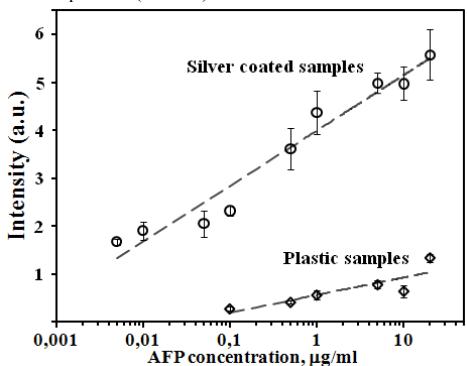
It was found that fabricated silver containing samples enhanced fluorescence in comparison to the reference signal from plastic substrates without silver coatings (Fig.1). Both concentration dependences were approximated by straight lines in logarithmic scale. The total fluorescence enhancement for AFP-anti-AFP – FITC complexes did not exceed 10 times. Linear section for silver coated samples is 5 ng/ml – 500 ng/ml (R2=0,98) (the medical threshold point for AFP in normal conditions is 5-10 ng/ml).