
Recently a significant advance was achieved in development of coherent and in-coherent broadband light sources leading to growth of applications ranging from attosecond pulse generation to optical coherence tomography. However, control of phase and polarization of such light sources exhibits a significant challenge as most of conventional optical elements exhibit strong dependence on wavelength. Here we exploit ultrafast laser nanostructuring for implementing broadband phase elements in particularly for “white” vortex generation.
Femtosecond laser imprinted birefringent optical element, S-wave plate, depending on the input light polarization, allows generation of azimuthally/radially polarized beams or optical vortex beam [1], with efficiency close to 99%.The S-wave plate is fabricated in the widespread silica glass, which exhibits high damage threshold level and wide transparency window. Until recently, this polarization and phase control method was considered as strongly wave length dependent with a typical bandwidth of tens of nanometers. However, we demonstrated that the S-wave plate, which is manufactured for the certain (e.g. 530 nm) wavelength, can be also used with other wavelengths, since the residual light, occurring due to wavelength mismatch, is orthogonally polarized to the optical vortex. As a result, after a polarization sensitive filtering with an achromatic quarter-wave plate and linear polarizer, the output beam results into a perfect high contrast optical vortex at any given wavelength. Moreover, this method can be successfully implemented for in-coherent light sources. To demonstrate this, the S-wave plate (manufactured by Altechna Ltd. for 532 nm) was illuminated with the halogen lamp with continuous spectrum from 400 nm till 830 nm. The collimated light was circularly polarized and then converted into optical vortex by the S-wave plate. The output beam was filtered as described above. At the output we obtained an optical vortex with deep node of intensity in the centre, which preserved its doughnut shape upon long distance free space propagation (Fig. 1). The resulting white vortex did not exhibit any spatial or spectral dispersion. The position of the node and structure of the beam was thoroughly examined with the narrow band interference filters (402-753 nm). Real colour images show no spectral components dispersion. To confirm the presence of the phase singularity and show the value of topological charge in the white vortex beam, it is being focused by cylindrical lens (description of the method see in the [2]).
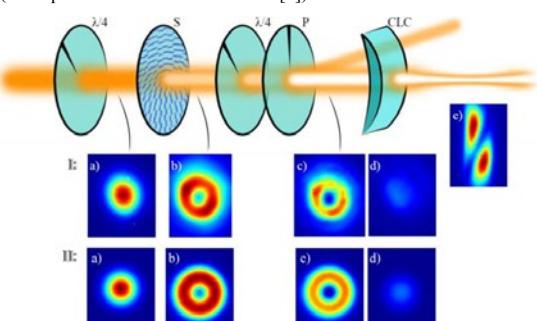
The white vortex generated by radial polarization S-wave plate converter has no disadvantages, that present in other methods on generation of white light optical vortices from non-coherent light sources, like spatial-, chromatic-, topological charge-dispersions.