
The need of low-cost renewable energy motivates scientific researches on looking for effective and cheap solar cells. One of potential solutions is hybrid solar cells, which can merge advantages of both organic and inorganic semiconductors, such as strong absorbance, mechanical flexibility, low specific weight of conjugated polymers, and high conductance and tunable band gap of inorganic nanocrystals [1].
In this research, we investigated photocurrent kinetics of new type hybrid solar cells created on the base of semiconductor nanocrystals doped polymer. The purpose of this research was to evaluate the mobility of electrons and holes and it dependence on composition and fabrication of samples.
Thin films (roughly 100 nm thick) with different mass ratio of poly(3-hexylthiophene) (P3HT) polymer and PbS nanocrystals were investigated by using "transcient photocurrent” and “charge carrier extraction by linearly increasing voltage" (CELIV) methods. By using the first method we registered photocurrent kinetics on several time scales (Fig. 1), and dependencies of charge carrier extraction times on applied electric field and polymer/nanocrystal composition ratios were evaluated.
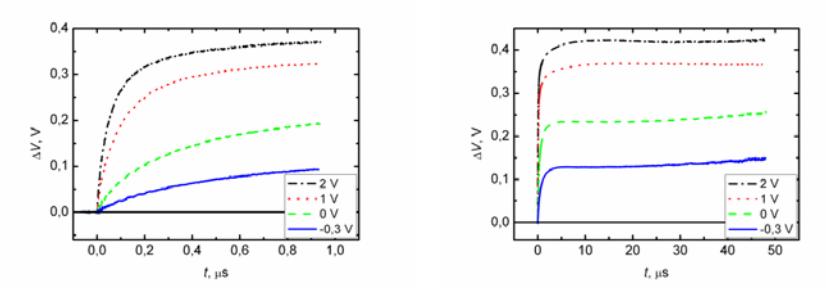
The results of research showed that photoconductivity of samples and charge carrier extraction times were strongly dependent on the sample composition ratio and fabrication procedures. Analysis of photocurrent kinetics and their dependencies on composition ratio enabled us to distinguish the electron and hole motion. By increasing concentration of polymer the mobility of holes increases, however, the mobility of electrons decreases. The extraction times were by about 5 times shorter in samples annealed during fabrication. Furthermore, qualitative analysis of the photocurrent kinetics revealed that the charge carriers extraction time can be expressed as $1/E\mu$ in all samples, where $\mu\sim\sqrt{E}$.
By using CELIV method only few samples were measured, because others had too high conductance. The results matched with those measured by the "transcient photocurrent” method.