Microfluidics is a science branch that investigates liquid behavior in ultra-small volumes (from micro- to femto-litres) and liquid interaction with various micro- and nanostructures. Achievements in this field pave the way for creation of great number of sophisticated microstructures that, combined with other components, could become independent multi-functional device also known as lab-on-chip (LOC) [1]. However, advancements of microfluidics greatly depend on what kind of structures can be created for liquid guidance and interactions in aforementioned scale. Requirements for these structures sometimes might be relatively contradictive: for example, channel system needed for experiments might be millimetres or even centimetres in overall size, but with micrometre sized channels or other features of this scale. Also, in order for structures like these to become widely used they have to be cheap and easy to produce in huge quantities. This puts most fabrication technologies to their limit and makes microfluidic research difficult and costly.
The goal of this work was to show possibility to produce microfluidical millimetre-sized components with integrated functional microelements combining fused filament fabrication 3D printing (3DP) [2] and direct laser writing (DLW) using femtosecond laser [3]. In this case, 3DP guarantees rapid and cheap fabrication of microchannels with size of hundreds of micrometers inside a structure that has overall dimensions in range from millimetres to centimetres. DLW, on the other hand, allows integrating intricate 3D microstructures into channels produced with 3DP. Structure fabrication utilizing only 3DP or DLW would lead to either insufficient spatial resolution if only 3DP is used or costly and long fabrication process if all structure is formed only with DLW.
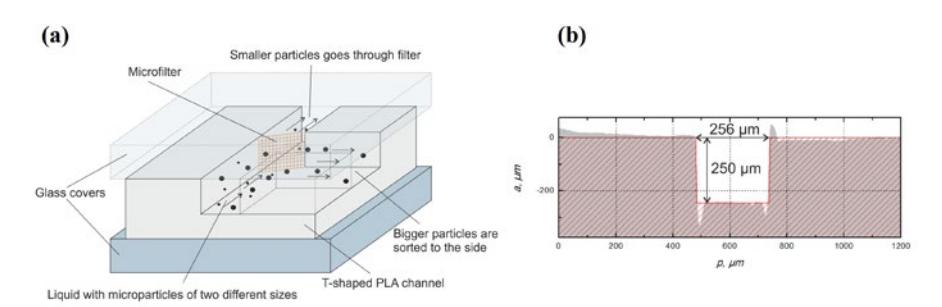
Results of this work include demonstration what types of channels could be produced using commercially available 3D printer Ultimaker original and polylactic acid (PLA) as main material for channel fabrication [4]. Channel characteristics, best fabrication parameters and arising problems are addressed. In case of DLW, we show fabrication of various microfilters. These components, when integrated in 3DP fabricated channels, could act as passive particle sorters [Fig. 1 (a)]. Filter geometry best suited for integration using DLW as well as filtering is discussed. Finally, novel method for sealing PLA channels with glass covers without using any additional glue is proposed and tested.