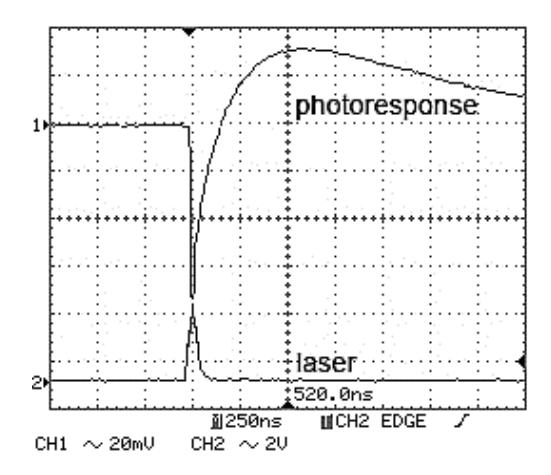
We present the results of an experimental investigation of photoelectric properties of GaAs p-n-junction illuminated with short laser radiation pulses of 1.06 µm wavelength. The p-n- junctions were fabricated by liquid phase epitaxy grown p-type 10 µm-thick layer on n-type substrate. The photoresponse voltage was induced across the junction when it was illuminated with the laser radiation. Typical oscilloscope traces of laser pulse and photoresponse pulse are presented in Fig.1. The observed photoresponse voltage U consisted of two components, U = Uf + Uph, where Uf is the fast component caused by the free carriers heating. The polarity of Uf corresponds to that of thermoelectromotive force of hot carriers. The slow component, Uph, has polarity opposite to that of Uf and is caused by electron-hole pair generation. Measurements of the dependence of photoresponse voltage on laser intensity P revealed that the fast component linearly depends on P, whereas Uph is proportional to P2. This fact indicates that the electron-hole pair generation is caused by two-photon absorption since the laser photon energy is less than the forbidden energy gap of GaAs.
It is worth to note that the influence of carrier heating on formation of photovoltage decreases with reverse bias applied on the p-n-junction. The same situation was observed earlier in narrow-gap semiconductor p-n-junctions under the action of intense pulses of CO2 laser radiation. [1]