
Traditional growth of InGaN structures for optoelectronic devices has focused mainly on c-axis oriented material where the polar axis is perpendicular to the growth plane. For InGaN/GaN multiple quantum wells (QW) electric fields resulting mainly from piezoelectric polarizations lead to shifts in the emission wavelength associated with the quantum confined stark effect and reduced emission efficiency due to the separation of electron and hole wave functions in the QW. With the use nonpolar growth orientation, the unfavorable effects of these polarization fields can be lessened. In this work, luminescence, absorption bleaching and carrier dynamics in nonpolar m-plane In0.15Ga0.85N single QW were studied using time resolved photoluminescence (TRPL), spectrally resolved differential transmission (DT) and light-induced transient grating (LITG) techniques. Carriers were excited selectively in InGaN QW, as pump energy was lower than a GaN barrier band gap. State filling properties, carrier lifetimes, and in-plane bipolar diffusivity over a wide excess carrier density range (2x10¹⁷ – 4x1020 cm-3) were investigated.
TRPL spectra were decomposed into Gaussian type components that were attributed to: (i) overlapping localized states and first two extended states (e1-hh1,2) at ~ 440 nm; (ii) high energy extended states, referring to the third QW energy level (e2-hh2), at 405 nm. The third peak appeared solitary in the absorption bleaching at 400 nm (e3-hh3) and was ascribed to the electronic transition between fourth QW energy levels. The internal quantum efficiency (IQE) was evaluated from low and high temperature PL measurements. Maximum (50 ± 10)% IQE was at 9x1017 cm-3 and decreased down to 4% with increased excitation (FIG. 1). Overall photoluminescence efficiency correlated with the absorption one up to nth = 3x1019 cm-3. Though, radiative recombination was determined by localized states, while prior carrier excitation was to extended states, i. e. excited carrier intraband redistribution was observed. Above nth IQE droop was explained by: (i) saturation of localized and lowest extended QW states and subsequent diminishing of radiative recombination from these states; (ii) enhanced carrier excitation to highest energy extended states, which was followed by increase carrier diffusivity and enhanced nonradiative recombination.
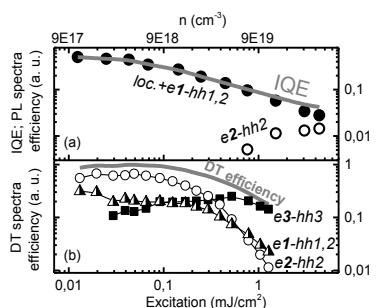
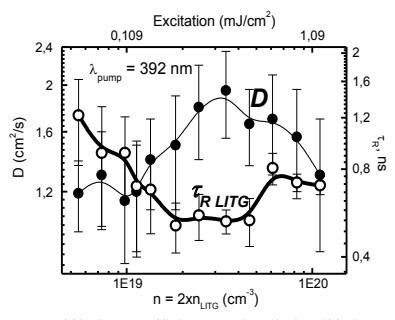
In respect to density-activated defect recombination model used for polar plane InGaN, carrier lifetime depended on in-plane diffusion coefficient for nonpolar one exclusively for nth < 3x1019 cm-3; afterwards, D saturated and immediately decreased from 2 to 1.2 cm2/s (FIG. 2). Increase of in-plane diffusivity also could be related to enhanced carrier generation to extended states – delocalization; it is supported by τLTG drop from ~ 1200 to 500 ps, referring to the lifetime in localized or free states, respectively. Subsequently, diffusion coefficient saturated as well as: (i) absorption to the third QW energy level started to prevail; (ii) PL from the second QW energy level appeared; (iii) IQE deteriorated to ~ 10%. These trends boosted with carrier concentration, meanwhile carrier in-plane diffusivity impaired. The origin of D drop at the highest photoexcitations (above nth) is not clear; tentatively, it can be attributed to additional scattering arising as the carriers occupy the high energy states and their wave functions expand into GaN barrier.