
Biological fluids have been in the centre of attention for many years, since they can be used as identification for various diseases. Only a slight change in the chemical composition could signal the existence of serious health problems. One example is uric acid which is an end product of purine metabolism. Its elevated or decreased concentration in various bodily fluids (blood, urine, tears) can suggest disorders such as gout, pre-eclamsia or cardiovascular disease. Thus, uric acid analysis in blood or urine is performed in order to evaluate kidney function. Various methods have been used for the analysis: enzymatic method, spectrophotometry, liquid chromatography, etc. [1]. However, these methods are far too rough when small concentrations of the sample molecules need to be detected.
Surface-enhanced Raman scattering (SERS) spectroscopy has been increasingly proposed as a method of choice for disease diagnosis and prevention [2]. The main advantage of SERS over conventional Raman spectroscopy is its significantly increased signal which allows detection of trace amounts of substances in the sample. Additionally, SERS can be applied in different ways which makes the experiment rather flexible. However, if one wants to use SERS spectroscopy in routine analysis, several problems, such as reproducibility of the enhancement factor, should be considered. In addition, suitable substrates should be selected according to the sample and available experimental conditions.
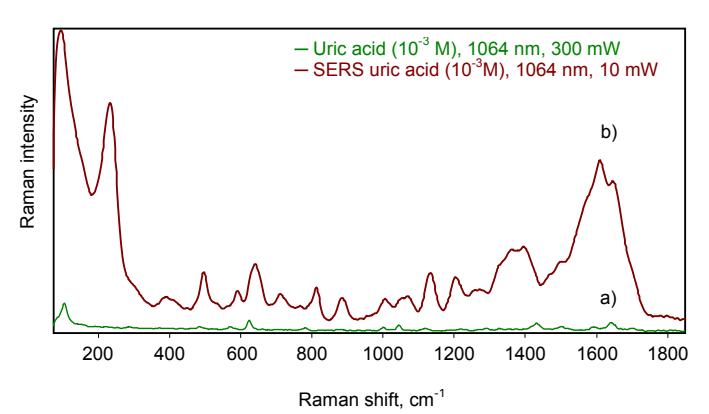
Using the colloidal approach of the SERS spectroscopy we have shown the advantages of this method in detection of the uric acid. This spectroscopic method is faster than conventional detection methods, as well as significantly lower concentrations of uric acid can be detected. The example of the SERS effect is shown in Fig. 1. Further application of SERS spectroscopy for intercellular fluid of the kidney tissue led us to believe, that SERS spectroscopy could be also used as a novel tool for detection of cancerous tissue areas from where the fluid is collected.
Surface enhanced Raman spectroscopy is a promising method for analysis of chemical composition in biological fluids. Despite the difficulties of choosing optimal experimental conditions the method delivers excellent insight into the changes of the chemical composition of biological fluids and can be considered as a powerful tool for detection of various health problems.