For a first few milliseconds after the Big Bang, the Universe was filled with hot and dense matter of deconfined quarks and gluons. This state of matter is called a quark-gluon plasma (QGP). In this system strong interaction reinteracts macroscopically and is not localised in a hadron as in ordinary matter.
Similar conditions to those of the very early Universe, can be created in particle accelerators when heavy ions collide. During lead or gold nuclei collision hundreds of protons and neutrons that make up the colliding nuclei are smashed into one another at energies of up to a few teraelectronvolts per nucleon. Inside this system the QGP can be created.
QGP due to its nature cannot be detected in the particle accelerators directly. However, it is possible to study its properties from particle distributions, which are created after the hadronization of QGP.
We examine the fluctuating initial conditions of heavy ion collisions at LHC ($ \sqrt{s_{NN}}=2760$ GeV) and RHIC ($ \sqrt{s_{NN}}=200$ GeV) energies. We show that it is possible to separate influence of fluctuations and collective dynamics to the Fourier expansion coefficients which can be measured by the experiment. We use the initial conditions to start the hydrodynamical evolution of the system and compare calculated particle multiplicity distributions and elliptic flow rapidity dependence with the experimental data.
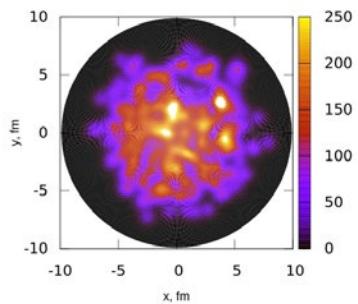
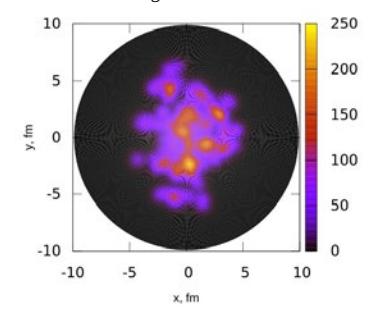
It will be shown, that using Glauber Monte Carlo model as the initial state (Fig. 1, Fig. 2) for the hydrodynamic evolution based on the approximate Landau solution we obtain particle multiplicity distribution and elliptic flow parameter distribution. Moreover, obtained results are in good agreement with the experimental data from LHC and RHIC colliders for a different impact parameters and at different collision energies.