
Juices are important because they contain vitamins, water and sugar that are vitally important to human body. Natural juices are more valuable than concentrates with various additional components therefore dishonesty can occur in declaring this information. The ratio of 13C and 12C isotopes are commonly encountered in the investigation of sugar adulteration in various products like fruit juices that naturally contain sugar [1, 2].
The main reason of this research was to investigate sugar adulteration in Lithuania's juice market using stable isotope ratio difference between different parts of juice (sugar and pulp). The method is based on naturally occurring carbon stable isotope ratio differences in sugar cane and sugar beet plants. It was established that more than 1.25 % difference between sugar and pulp of the same juice means sugar addition of the different type of plant [3].
Data are presented of stable carbon isotope ratio analysis on Lithuania juice market. Randomly selected 24 various juice samples were collected in freely available Vilnius supermarkets. Juice samples were chemically prepared to isolate sugar and pulp according to ISO standards (“PN-ENV 12140:2004 Fruit and vegetable juices – Determination of the stable carbon isotope ratio (13C/12C) of sugars from fruit juices – Method using isotope ratio mass spectrometry” for sugar and “PN-ENV 13070:2004 Fruit and vegetable juices – Determination of the stable carbon isotope ratio (13C/12C) in the pulp of fruit juices – Method using isotope ratio mass spectrometry" for pulp). The samples were put in the tin capsule, weighed and measured with the elemental analyzer (Thermo Flash EA1112) coupled to the isotope ratio mass spectrometer (Thermo V Advantage) via ConFlo III interface. Analysis revealed that 4 of 24 juices contained additional cane sugar. Furthemore, 3 of 4 juices according to the manufacturer did not have got any additional sugar.
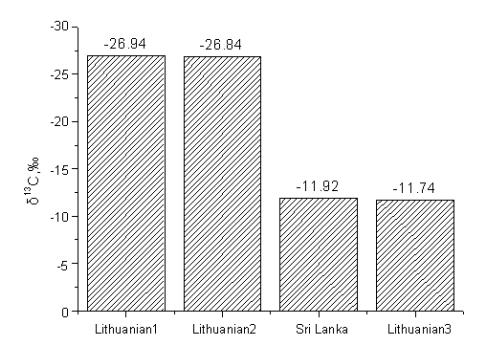
Values of pulp ranges from -27.51 % to -23.48 % and sugar -26.88 % to -16.98 %. Except one of juice's that was pineapple results clearly showed that this is C4 plant because results were -13.16 % of pulp and -12.91 % of sugar.
The obtained results showed the applicability of isotope ratio mass spectrometry method for the fruit juices adulteration revealing.