
Photonic crystals (PhCs) have been shown to exhibit unique properties that can result in some interesting phenomena, such as negative refraction, flat lensing, non-diffractive propagation of light, super-prism effect, chromatic and spatial filtering of light, etc, all of which can be realized through selective dispersion engineering. Here we discuss an alternative method of spatial beam shaping, enabled by the gap-less spatial filtering phenomenon [1]. Previously, such PhC filters of 2D rectangular geometry were demonstrated [2], facilitating the deflection of potentially unwanted spectral components to diffraction maxima, however some applications may require high quality beams with an uniform angular spectrum in all radial directions.
We present results of our recent study on design, experimental realization and performance of axisymmetric photonic crystals [3]. Such PhCs are comprised of modified refractive index concentric rings with a periodically varying radius, arranged in periodic layers in a sequential negative-positive manner Fig. 1 (a). PhCs were fabricated using the direct laser writing technique in a soda-lime glass medium and characterized by measuring the angular transmission spectrum of a 633 nm HeNe laser beam. The resulting PhC structures had a 25 mrad wide filtered out areas of 65 mrad central filtering angle (Fig. 1 (b)), which can be tuned by varying the PhC's period lengths (even employing chirping [4] to increase widths of the filtered out areas Fig. 1 (c)). Gap-less spatial filtering is advantageous due to the experimentally achievable PhC period lengths, which in our case were 2 μm for transversal and 13.4 μm for longitudinal directions.
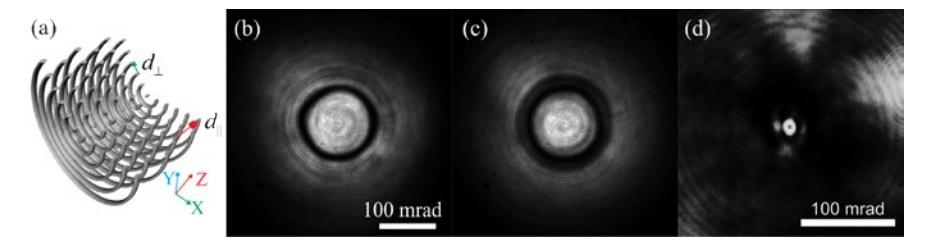
Additionally, the super-collimation [5] effect has been experimentally observed. It leads to an accumulation of intensity for the near optical axis beam components by depleting the higher spatial frequency components. This effect is visible for PhCs that are of approximately double length compared to PhC filters, and requires near axis spatial filtering. Experimental observation of energy concentration near axis in axisymmetric PhC showed, that a collimated beam was formed. Said beam had a divergence of 20 mrads and an intensity increase of 7 times Fig. 1 (d). Numerical calculation show that a more than 20 times intensity increase can be expected if fabrication conditions could be optimized. We emphasize, that this effect is not observed in conventional 2D or 3D woodpile PhCs.
The results of our studies in combination of numeric optimization techniques might be utilized in miniature spatial beam filters or shapers, possibly replacing current rather bulky filters, consisting of two lenses and a pinhole.