
Essential oils are used for thousands of years in various cultures for medical purposes. These healing oils are rapidly growing in popularity because they act as natural medicine without side effects. Essential oils benefits come from their antiradical and antibacterial properties [1]. These parameters are affected by many factors. One of them is drying methods of raw materials.
The objective of this study was to evaluate the influence of seven drying methods (natural air, convective, forced flow dryer at ambient temperature, vacuum, infrared, microwave and freeze-drying) on essential oil antibacterial and antiradical activities of thyme (Thymus vulgaris L.). The essential oils were obtained by hydrodistillation from thyme. Results of antibacterial and antiradical activities of essential oil from thymus are described in Fig. 1.
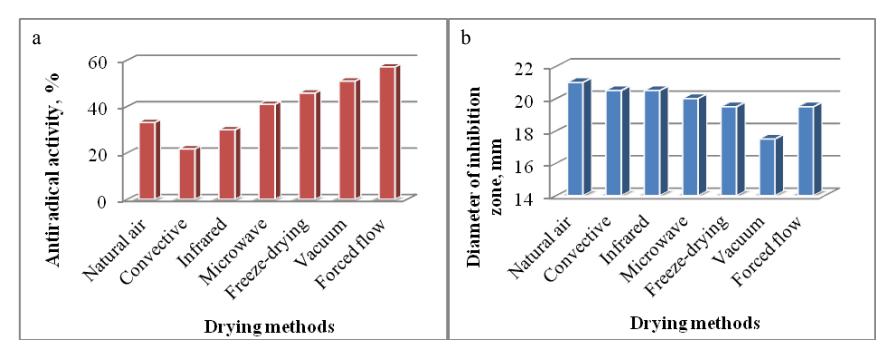
The highest antiradical activity of essential oil from thyme was then plant was dryed after flow drying at ambient temperature (57.09 %), the lowest – after convective drying (21.77 %). The strongest antibacterial activity against Rhizobium radiobacter was obtained after natural drying (21 mm), the weakest – vacuum drying (17.5 mm). The most suitable drying method of thyme for antiradical and antibacterial activities was flow drying at ambient temperature.