1,8-Naphthalimide derivatives are already being widely used in organic light-emitting diode devices, as nerve cell markers, metal, ion and other detector devices due to strong photophysical properties and customizable molecular structure with wide variety of different substituents. Better understanding of the charge transfer state recombination would allow naphthalimide derivatives to be used for more precise and controlled probe devices and in OLED technologies.
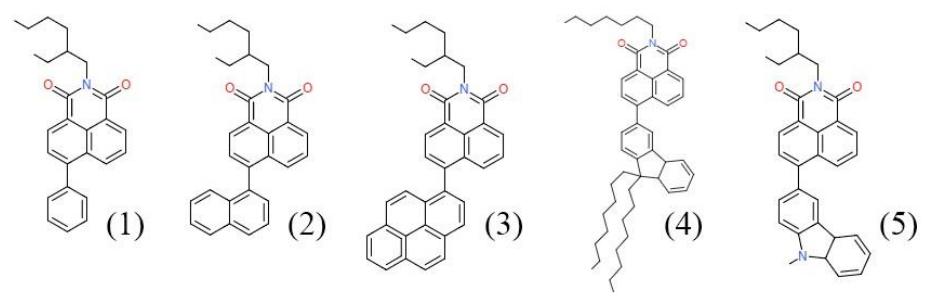
In this work fluorescence and phosphorescence properties of naphthalimide derivatives with fenil, naphthalene, pyrene, fluorene and carbazole substituents (Fig. 1) were optically investigated. At first, the fluorescence emission spectra dependency on solvent dielectric constant of 1,8-naphthalimide modified with carbazole moiety (5) was found to exhibit a very pronounced solvatochromic effect, redshifting emission peaks from 437 nm when dissolved in cyclohexane to 625 nm in dilute dimethyl sulfoxide solution. 1,8-naphthalimide with fluorene substituent demonstrated almost linear fluorescence quantum yield (QY) dependency on solvent dielectric constant in the range from 2.4 (90.5%) to 46.7 (14%). We found that decreased QY is related to the drastically increased non-radiative recombination rate (from 37.5 ns in cyclohexane to 0.6 ns in DMSO). In our previous works it was shown that the introduction of fluorene fragment into 1,8-naphthalimide backbone (4) exhibited reversed tendencies compared to 1,8-naphthalimide-carbazole compound (5). Changing solvent dielectric constant from 2.4 to 46.7 resulted in QY increase from 50% to 84% and non-radiative fluorescence recombination rate decrease from 2.4 ns to 27 ns.
A detailed analysis of the photoluminescence properties were completed by determining emission spectra intensity dynamics in time. 1,8-Naphthalimide derivatives with fenil, naphthalene, pyrene, fluorene and carbazole substituents (Fig. 1) were investigated at 15K temperature under helium atmosphere. Several charge transfer state recombination channels were determined. Initially, all compounds showed the fluorescence spectra, resulting from the charge transfer from HOMO band, concentrated on an attached moiety, to LUMO band on 1,8-naphthalimide core. Fluorescence spectra peaks shifted from 412 nm, of the least $\pi$-conjugated 1,8-naphthalimide-fenil derivative (1), to 480 nm of 1,8-naphthalimide-carbazole compound (5) and lasted for up to 80 ns. Redshifted by up to 50 nm the delayed fluorescence was observed continuing for about 100 μs and it is governed by the triplet-triplet annihilation (TTA) [1] process. All of these structures, apart from demonstrating the phosphorescence emission spectra ranging from 572 nm for 1,8-naphthalimide-fenil structure (1) to 593 nm for 1,8-naphthalimide-carbazole compound (5) and lasting beyond the 100 ms mark, also exhibited an intermediate triplet type emission spectra ranging from 477 nm for 1,8-naphthalimide-fenil derivative (1) to 510 nm for 1,8-naphthalimide-pyrene compound (3). We have shown that this emission maxima is correlated with the substituent $\pi$-conjugation length. Intensities of the spectra, generated by triplet state recombination processes, were compared in non-polar and polar solvents for (4) and (5) compounds allowing to deduce that the charge transfer state recombination through triplet type processes is not the main pathway for non-radiative recombination.
In conclusion, naphthalimide derivatives exhibits not a straightforward QY dependency on solvent dielectric constant, 1,8-naphthalimide-fluorene structure (4) and 1,8-naphthalimide-carbazole derivative (5) being the most pronounced examples of the high sensitivity on charge transfer energy state and charge transfer recombination rate.