Graphene, a two dimensional crystal made of carbon atoms, has driven a lot of research in condensed matter, for its mechanical, electrical and topological properties. However, its discovery was only the beginning of a new and exciting adventure in the world of two dimensional crystals, where many other systems are being discovered. With them, novel and exotic properties are no longer material science fiction.
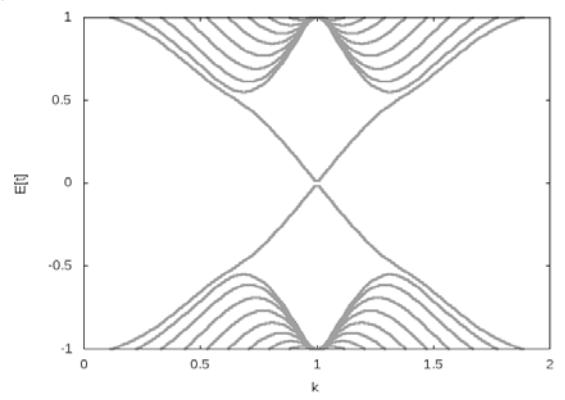
In this work we investigate electrical properties of graphene nanoribon using Hubbard model and the Kane-Mele spin-orbit coupling[1]. I show the transition from two-dimensional semimetallic state to a quantum spin Hall insulator in graphne (fig. 1). Topological insulators are special electronics systems which show insulating bulk properties, but protected metallic edge properties.