
Titanium oxide presents many interesting properties in various fields. The most remarkable that titanium oxide is transparent in visible range of the electromagnetic spectrum, it has extraordinarily high dielectric constant and presents three polycrystalline phases, in particular rutile, anatase and brookite [1].
Magnetron sputtering (MS) technique was employed for TiO2 thin films deposition using direct current (DC), radio frequency (RF) and high impulse power MS (HiPIMS) methods. MS deposition is a widely used process for depositing metal and ceramic films for semiconductor applications, optical coatings, magnetic media and etc. High deposition rates and the possibility to carry out ion assisted growth are primary advantages of this technique [2]. High power impulse magnetron sputtering is an emerging physical vapor deposition technology. It is characterized by a high pulse power density at the sputtering target, which is typically two orders of magnitude greater than the average power density [3]. Measurement were carried out by scanning electron microscopy for layer mass thickness parameter and spectroscopic ellipsometry for its thickness.
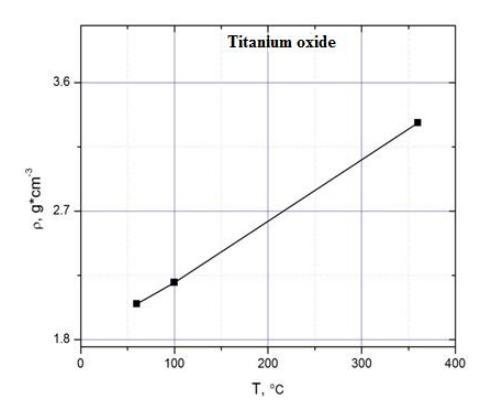
Higher density of the titanium oxide film can be achieved by varying the conditions of the deposition process. Increased temperature of substrate during the sputtering shows higher density even for standard DC process. It's shown in figure 1.
Obtained densities using HiPIMS technology are denser than other compared magnetron sputtering methods of the same power applied to the target.