
Metal-organic framework (MOF) compounds are a new type of porous ordered solids, which consist of metal ions connected by organic linker molecules [1]. These materials exhibit high porosity and aesthetically attractive underlying topology, drawing scientific and technological attention. The porous structure of MOFs makes them good candidates for gas adsorption, storage and separation [2]. In addition, the diverse magnetic, multiferroic, chiral and photoresponsive properties of these solids attract interest of physicist and material researchers [3].
In the presented work a novel mixed valent MOF with chemical formula $3\%[Cu(I)_2Cu(II)_2\{H_2O\}_2\{(Me-trz-mba)_2thio\}_2]Cl_2$ is investigated by the means of the continuous-wave (CW) electron paramagnetic resonance (EPR) spectroscopy at X- and Q-band frequencies in a wide temperature range. The main building block of this compound is a so called Cu2 paddle-wheel (PW) unit, which contains two Cu(II) ions connected via four carboxylate groups. The obtained EPR data allowed us to detect and investigate three distinct magnetic interactions which differ by the three orders of magnitude and are related to the Cu(II) pairs (see Fig. 1).
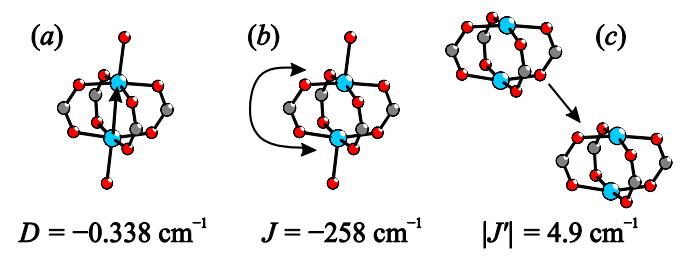
At higher temperatures the fine structure pattern was observed in the EPR spectra and by means of spectral simulations the spin-spin interaction tensor D was determined (axial zero-field splitting parameter D = -0.338 cm-1). The origin of this pattern was assigned to the thermally populated excited triplet states of the cupric ion pairs. From the temperature dependent CW EPR experiments of the as-synthesized material it was found that these two cupric ions couple antiferromagnetically with the exchange coupling constant J = -258 cm-1. The influence of the sample dehydration is also investigated and it is observed that the spectra of such samples show pronounced isotropic Lorentzian line indicating an inter-paddle wheel exchange. By simulating the powder pattern of this inter-dinuclear exchange line, the exchange coupling between neighboring PW units was determined (|J'| = 4.9 cm-1).