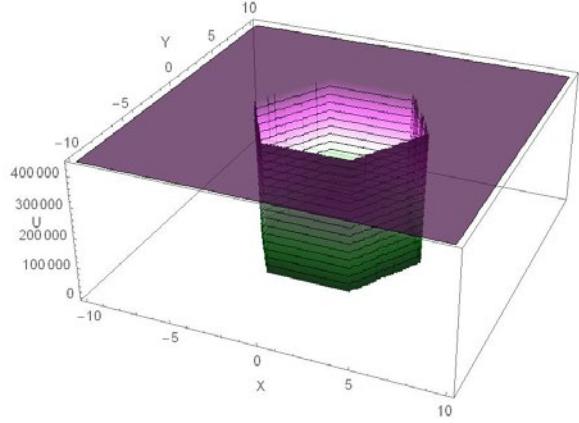
In solid-state physics and semiconductors is very urgent problem of calculating the energy of the stationary states of an electron in the potential wells of different configurations. The height of the barrier can be finite or infinite. For some simple configuration of the well an analytic solution exists. But in general case numerical solution of the Schrödinger equation is necessary. The main problem is the correct representation of the vertical potential step. Really if we want to find values of the stationary states of electron in hexagonal well we can set values of potential energy in nodes of the regular 2D grid equals to zero if node within hexagonal and equals to $U^{0}$ if node outside (Fig.1).
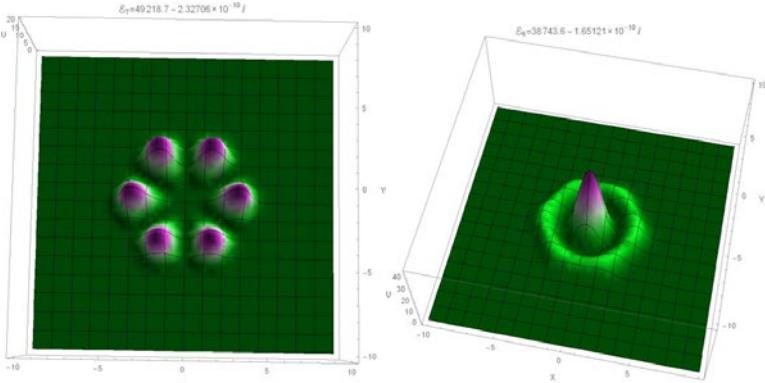
Then analytic representation of this 2D PES is necessary. At first we tried to do this using Fourier series. But because of the Gibbs beats to get an exact solution is impossible mission. So we applied DVR method because it does not need analytical representation of the PES at all. Note that the slope of the step is determined by the grid spacing at a constant barrier. So in doing so we were able to reproduce well existing analytical solution for square well, and to get solution for hexagonal well. Wave functions for some of exiting stationary states of electron in hexagonal well is shown on Fig.2