
Electronic components and systems used in the industry, defense and infrastructure are becoming smaller and more complex. This means that they are becoming more susceptible to the effects of electromagnetic fields [1]. Furthermore the ongoing technological advancement means that high power electromagnetic radiation sources are getting smaller, cheaper and more common place. Exposure to microwave pulses may affect the operation of computers, security and communication systems and computer networks. Operation of such systems can be temporarily suspended or irreparably damaged [2]. Even automotive vehicles and boats may be stopped or even damaged by directed electromagnetic radiation [3]. Therefore it is of paramount importance to adequately protect key electronic equipment from incidental or directed electromagnetic interference.
Usually electromagnetic fields are measured using low-power and average-power measurement equipment. Such equipment cannot reliably detect short or single pulse radiation which is usually generated by compact generators trying to effect the operation of electronic equipment. By incorporating resistive sensors (RS) [4] high power pulses may be measured. Such detectors are very resistant to overload and can be used without attenuation therefore increasing the accuracy and reliability of the measurements.
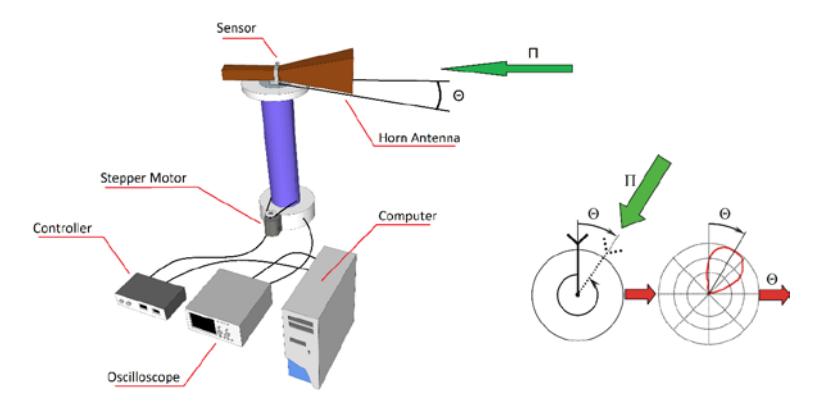
A microwave interference detection system created incorporating an RS and a mechanically rotating positioning system is shown in figure 1. The main advantage of such an arrangement is the simplicity and precision of detecting the source of radiation the other advantages being economy of manufacture and the ability to detect strong electromagnetic fields without damage to the sensor. The system is comprised of a computer running dedicated software which controls a microcontroller operated positioning system used to rotate a highly directional horn antenna in a controlled and precise manner. The signal is detected using an oscilloscope connected to the RS. Data from the oscilloscope is collected and analyzed by software and a polar plot of the signal amplitude is generated. This plot is then used to calculate the angular position of the radiation source and the antenna is turned to that position to continue the monitoring of the interference.
The current system can precisely (<1,5) point out the source of the radiation up to 200 kV/m in 1-12 GHz frequency range and has been tested in laboratory and on field trials in Norway according to the international project HIPOW, documented on NATO scientific program channel on YouTube [5].