
Ion nitriding have number of advantages over another conventional nitriding processes such as gas nitriding or nitriding in salt bath [1]. This process is widely used in the manufacturing and machining industries, primarily to treat tools for hot and cold work [2]. Studies of nitridation carried out in the past shown that microstructure of the surface layer can be affected by changing temperature, time and gas mixture ratio [1, 2]. In this paper we represent the investigation of 65G spring steel nitrogen concentration distribution on the depth after nitridation process.
Samples of 65G spring steel of dimensions 37.5x8x1mm were used for this study. The alloy studied here has the following composition (wt. %): C, 0.62 - 0.7; Si, 0.17 – 0.37; Mn, 0.9 – 1.2; P, 0.035; S, 0.035; Cr, 0.25; Ni, 0.25; Cu, 0.2; and Fe, balance [3]
The samples surfaces were carefully mechanically grinded and polished. Before nitridation all samples were cleaned with ethanol and boiled in acetone. Nitridation processes were accomplished using "Usi-Ionic" equipment. Process was continued 30 min in nitrogen atmosphere (N2 99.6%) and temperature of samples was approximately 100 °C. Direct ion-nitriding was implemented at low-pressure nitrogen gases (0.7 Pa). Six samples were ion-nitrided at three different energies of nitrogen ions: 100, 250, and 400 eV while ions current density was 0.08; 0.15; 0.24 mA/cm2 respectively.
65G spring steel depth profiling spectra was acquired by "Escalab 250 xi" XPS spectrometer. The profiling was realized using "ESCALAB 250Xi MAGCIS" ion gun [4] where argon (Ar+) ions energy was 500 eV. The sputtering was done by three difference regime - the sample surface was sputtered 9 times for 5, 10 and 100 second respectively in each regime. Sputter rate for metal oxide and metal was calculated using sputter yield ratio [5, 6]. Atomic concentrations were calculated using software "Fityk" [7]. Results of calculated nitrogen, carbon and oxygen concentrations are represented in Figure 1.
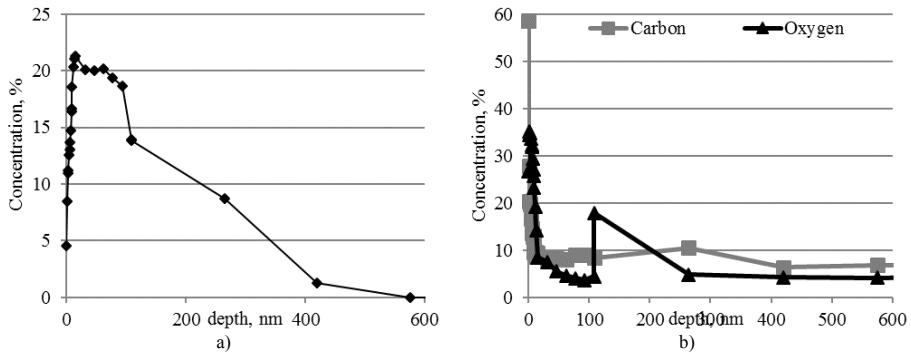
As one can see from this picture, nitrogen penetration depth exceeds 400 nm. Highest value of nitrogen centration was observed at 15 nm depth after 75 s of sputtering. Also there is plateau-type part of the curve were concentration value is approximately 20 %. This plateau-type of curve may be cause of ion-implantation and diffusion influence.