
Mercury ions (${\text{Hg}}^{2+}$) are one of the most hazardous environmental pollutants because they can be bioaccumulated through the food chain and cause great damage to the nervous system even in low concentrations [1]. Due to its specific properties it is widely used in industry where pollution is sometimes inevitable. Another transitional metal ion that is important to human health is iron (${\text{Fe}}^{2+}$) which is abundant in mammals. The lack of iron can result in anemia, hemochromatosis, liver damage, diabetes and cancer, while the excess of iron can induce several serious diseases, such as Alzheimer's, Huntington's and Parkinson's diseases [2]. Therefore it is important to sense ${\text{Hg}}^{2+}$ and ${\text{Fe}}^{2+}$ in environment and living organisms. High sensitivity, rapid response, low cost and easy operation makes fluorescence sensors exceptional in this field. Naphthalimide derivatives have gained increasing interest as fluorescent probes for metal ions because of their unusual photophysical properties [3].
In this paper we investigated photophysical properties of 4-(4-dimethylaminophenyl)-N-(2-ethylhexyl)-1,8-naphthalimide (NI) in the absence and in the presence of the salts of several transition metal ions. The naphthalimide derivative was synthesized by prof. J. V. Gražulevičius group at Kaunas University of Technology (KTU).
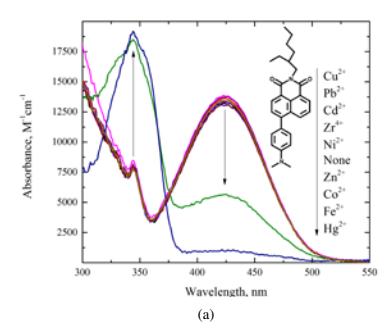
The UV-vis absorption spectra of NI in tetrahydrofuran (THF) solution (4 \times 10-6 M) were investigated in the presence of transitional metal ions ${\text{Mn}}^{2+}$, ${\text{Fe}}^{2+}$, ${\text{Co}}^{2+}$, ${\text{Ni}}^{2+}$, ${\text{Cu}}^{2+}$, ${\text{Zn}}^{2+}$, ${\text{Zr}}^{4+}$, ${\text{Hg}}^{2+}$, ${\text{Pb}}^{2+}$ (Fig. 1. a). With none cations the absorption spectrum exhibits large peak at 423 nm which is typical for charge transfer (CT) state and a small peak at 345 nm typical for 1,8-naphthalimide. Addition of mercury or iron ions to the solution led to some drastic changes of absorption spectrum while other transitional metals did not influenced it. Complexation of ${\text{Hg}}^{2+}$ or ${\text{Fe}}^{2+}$ ions with NI led to quenching of CT state absorption (423 nm) and enchantment of 1,8-naphthalimde absorption (345 nm) therefore leading to visible color change of the solution.
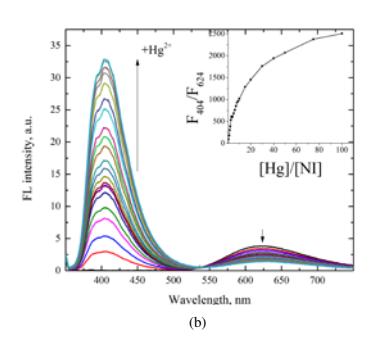
Further we investigated fluorescence spectra of NI without and with the presence of metal ions in THF solution when exciting at 345 nm. The obtained data revealed CT state fluoresce peak at 623 nm and a small peak typical for 1,8-napthalimide at 404 nm. The introduction of transitional metals to solution again showed that NI reacts only with iron and mercury ions hence quenching CT fluorescence and enchanting locally excited state fluorescence up to 1000 times. When increasing the concentration of metal ion gradually, the fluorescence is enchanted coherently (Fig. 1. b) thus giving a linear sensitivity to concentration of ions in range from 0.5 to 10 equivalents of NI concentration.
The results show that 4-(4-dimethylaminophenyl)-N-(2-ethylhexyl)-1,8-naphthalimide is very sensitive to iron and mercury ions and therefore can be used as highly selective sensor of these ions.