
The amount of crystallographic defects is one of the most important factors when evaluating the quality of single-walled carbon nanotubes (SWCNTs). It is known to affect the physical properties of this promising nanomaterial, often reducing its suitability for potential applications. The structure of commercially produced SWCNTs is especially prone to disorder; therefore, reliable methods are needed to improve it. FT-Raman spectrometry can be successfully applied to monitor the quality of carbon nanotubes [1].
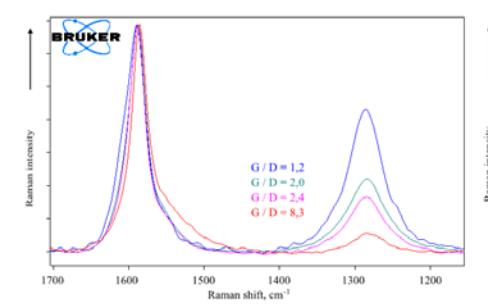
The aim of this work is to investigate the structure of SWCNTs in different environments and evaluate the impact of bombardment by argon ions. SWCNTs and KBr were mixed in various proportions, and high pressure was applied in order to prepare the samples. FT-Raman spectrometer Bruker MultiRAM equipped with a 1064 nm Nd:YAG laser was used to obtain the Raman spectra. By calculating the ratio of the intensities of G and D bands, it was found that the amount of defects depends on the environment surrounding the SWCNTs – it can be expected to increase as the concentration of SWCNTs decreases (Fig. 1).
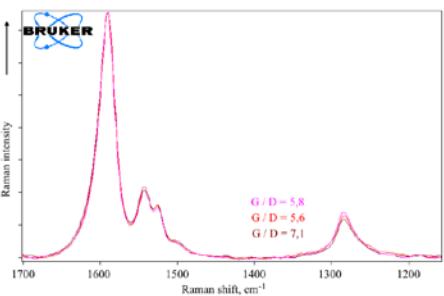
After the initial measurements, some of the samples were bombarded by argon ions, and further spectrometric analysis was carried out. It can be tentatively stated that the interaction with low-energy ($E < 5 \text{ eV}$) argon ions improves the structure of SWCNTs (Fig. 2), while, on the contrary, ions of higher energy can break the C-C bonds and disturb the ordered structure of the nanotubes. However, the heterogeneity of samples should be considered when evaluating the results.
FT-Raman and FT-IR experiments on both chemically unaltered and functionalized SWCNTs are intended in the near future.