Molecular switches can be shifted between states in response to external stimuli. The trigger used to switch between the states can be an electrical current, a change in temperature, chemical environment, or light. This property makes them an attractive component in sensor design.
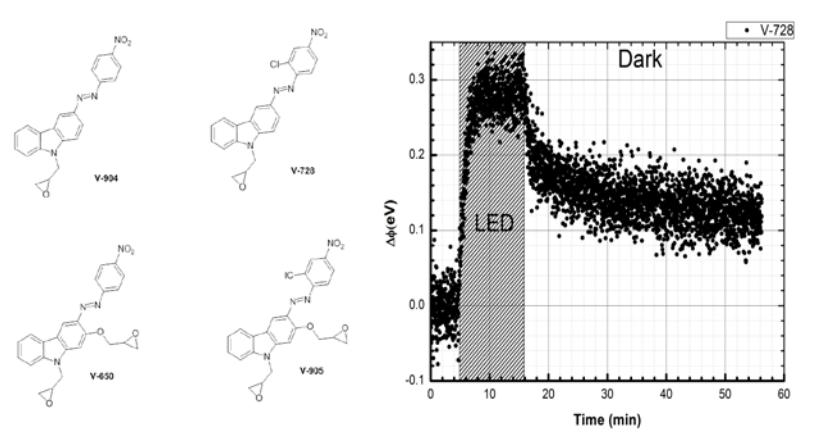
In this work we studied light photoisomerisation of various azophenylcarbazole compounds chemsorbed to gallium nitride. When exposed to a source of light photo-excitation causes azophenylcarbazole compounds to switch between trans and cis states. The change in geometry of a molecule modifies its dipole moment. When azophenylcarbazole compounds are chemsorbed to GaN surface change in dipole moment causes a corresponding change of work function[1, 2].
A self-assembled monolayer on GaN was formed by hydroxylating GaN by piranha etch and then immersing into solution containing azophenylcarbazole compound. Work function difference measurements were performed using Kelvin probe. Switching is performed by illuminating samples with $\lambda$ = 440nm light source. These measurements were compared with measurements performed on unmodified GaN in order to find work function differences between cis-trans and trans-cis conformations and corresponding time constants.