In 2012 two particle physics experiments at the Large Hadron Collider (LHC) at the laboratory of European Organization for Nuclear Research (CERN), ATLAS (A Toroidal LHC Apparatus) and CMS (Compact Muon Solenoid), announced a discovery of a new bosonic particle [1, 2]. Later it was confirmed to be the sought Higgs boson, with the properties predicted by the Standard Model [3]. The mass and the couplings of the Higgs boson to other particles had to be measured, and the hadron calorimeter played an important role for this goal. These precise physics measurements would not be possible without an adequately calibrated instrumentation. Currently the LHC experiments are getting ready for the next round of proton-proton collisions at an increased collision energy of 13 TeV ("Run 2"). A strategy for the calibration of the particle-detecting systems is being revised.
The CMS hadron calorimeter, made of brass and scintillator, has a poorer energy resolution than other subsystems of the detector, including the electromagnetic calorimeter. This can be taken into account considering the possibilities of its calibration. The accuracy of the measured hadronic energy could be improved analyzing the results of the physical processes where all available energy is measured by the detector. Some products of proton-proton collisions escape undetected due to the construction of the detector that needs to have holes at the ends along the symmetry axis in order to allow entrance of the colliding particles (the "beam axis"). This creates an ambiguity of the momentum measured along the beam axis. The CMS detector registers all known particles with an exception of neutrinos. Neutrino-less reactions allow accurate measurement of the momentum in the plane that is transverse to the beam axis, since there is no movement in this plane before the protons collide. The simplest case is to have two physical objects that would move in the opposite directions in the transverse plane after their production in a proton collision. Their measured transverse momenta should be equal.
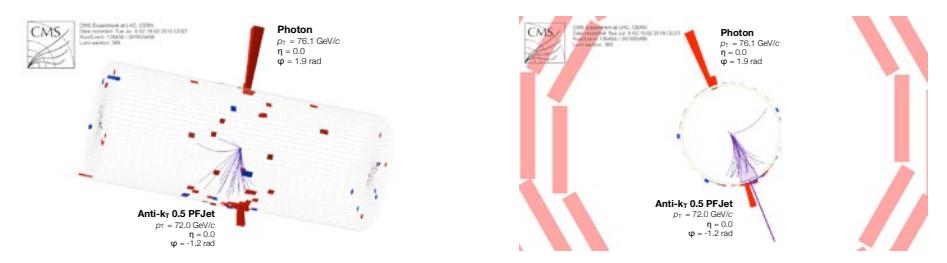
Two physics processes are being considered, namely, the production of two jets and the simultaneous photon and jet production. (An example of a photon and jet event in the CMS detector is shown in Fig. 1.) Momentum balancing was previously used to calibrate the measured jet energy (see e.g. [5]). It can also be employed to derive the calibration coefficients for the hadron calorimeter. The presented discussion focuses on the calibration in rings that are defined as a set of ranges of the radial angle from the beam axis, $ \theta $ (transformed into a pseudo-rapidity variable $ \eta $). A ring uniformity around the beam axis is assumed.