
Sr2FeMoO6-${\delta}$} (SFMO ) is half-metallic ferromagnet with variety of magnetic states and physical properties, which are caused by interrelation of orbital, charge, spin and lattice degrees of freedom. These materials have a significant magnetoresistance (MR) $\sim$ 38% in a relatively weak magnetic field (B $\approx$ 1T) at T = 50K, high values of Curie temperature (Tc = 400-450K) and almost 100% degree of spin polarization [1-3]. Increasing the superstructural ordering of Fe and Mo cations increases the density of free charge carriers at the Fermi level D (Ef), thereby enhancing the intensity of ferromagnetic and metallic properties of double perovskite [2, 3]. During the point defects formation in double perovskites iron cations may exist in different spin states: the low-spin, intermediate and the high [1-3]. The presence of zero-defects in the structure SFMO is determined primarily by the synthesis conditions and microstructure of samples and especially for nanoscale grain size. So the magnetic properties of the double perovskite affect particle size and shape of their morphology, particle interaction with each other.
Nanosize powder of SFMO with an average grain size of 50-350 nm was obtained using citrate-gel method. Based on the information obtained through the analysis of pH (pH=2, 4, 6, 9) and temperature effect on the phase composition and morphology during SFMO synthesis, an improved procedure was designed. Temperature dependences of SFMO magnetization were measured in next modes: pre-cooled from 300 to 4.2K in a magnetic field (FC-field cooling) or without (ZFC-zero field cooling) followed by heating to 300K at various magnetic fields [Fig.1.].
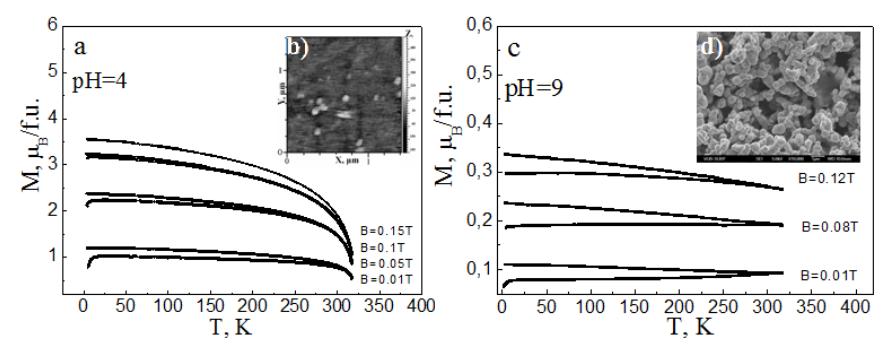
According to the magnetization data measured in ZFC and FC regimes it was found that the magnetic state of the samples correlates with their heterogeneity in sizes and shapes of SFMO grains. Thus, the presence of nanoscale spherical shape grain in SFMO nanopowders in which exchange forces provide uniform magnetization contributes to realization of superparamagnetic state, as indicated by the temperature dependence of ZFC in the low temperature region at T = (4.2 - 19) K. An important advantage of obtaining SFMO powders using such method is the possibilities of further use of these compounds in the injectors of spin polarized electrons, as electrode for SOFC, for spin transistors, for sensors of weak magnetic fields, for recording and processing information, etc [4, 5].