
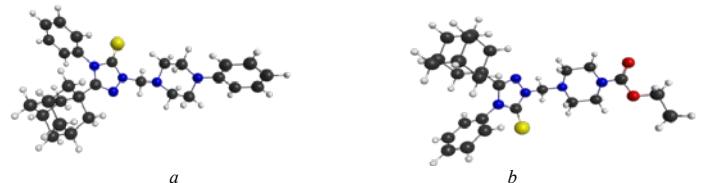
In modern chemistry one of the important problems is the synthesis of biologically active derivatives of adamantane, which can later be used as medicines. Now many derivatives of adamantane already tested for biological activity and in most cases have shown a positive result. Derivatives of adamantane have long been known for their antiviral activity against Influenza A and HIV viruses, also associated antimicrobial and anti-inflammatory activities. In this work was made analysis of the newly synthesized molecules 3-(adamantan-1-yl)-4-phenyl-1-[(4-phenylpiperazin-1-yl)methyl]-1H-1,2,4-triazole-5(4H)-thione ($C_{29}H_{35}N_{5}S$, compound I) and ethyl 4-{[3-(adamantan-1-yl)-4-phenyl-5-sulfanylidene-4,5-dihydro-1H-1,2,4-triazol-1-yl]methyl}piperazine-1-carboxylate ($C_{26}H_{35}N_{5}O_{2}S$, compound II) (Fig. 1). The mechanism of the antibacterial activity of those compounds is uncertain. The present study deals with the investigation of the structural and vibrational properties of those molecules to achieve a better understanding of the properties of such derivatives with the hope that the results would be helpful in the prediction of its mechanism of biological activity.
Raman scattering spectra (Fig. 2, a, b) have been measured using a solid-state cwNd:YAG laser (second harmonic, 532 nm wavelength), a holographic notch filter, a grating spectrometer (600 grooves per mm) Spectra Pro500i and a silicon cooled CCD-camera. Computations of the structural and spectral characteristics of the molecules (Fig. 2, c, d) were realized with the use of the quantum chemical package GAMESS-US. Optimization of the equilibrium structure, computations of force fields, Raman spectra frequencies and intensities in the harmonic approximation were performed using the standard cc-pVDZ basis by DFT methods with the help of the hybrid B3LYP functional.
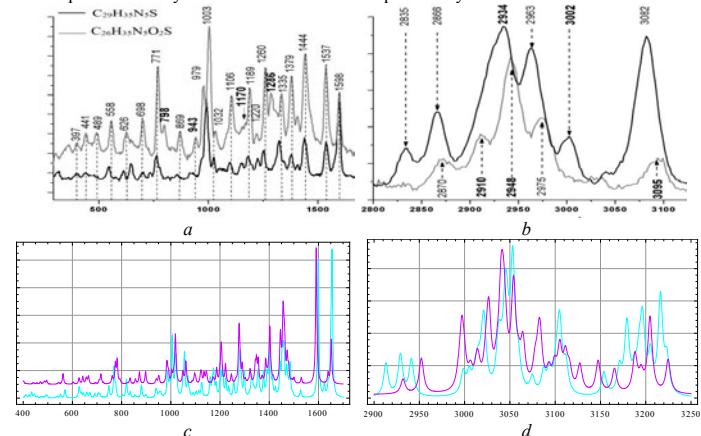
Based on analysis of the calculated and experimental spectra is made consistent interpretation of Raman spectra, which can be used for practical purposes objective. We identified the vibrations of different functional groups of the title molecules: adamantane, piperazine, benzyl-triazole, benzyl alcohol and carboxylate. The characteristics of the calculated Raman vibrational spectra correlate well with the experimental data.