
At the time when any possible clean energy sources are intensely sought-after, metal borohydrides are intensely investigated as potential chemical hydrogen storage materials. Their thermal decomposition seems to be one of the most promising methods of release of hydrogen fuel. Looking from a different angle, hydrogen evolution from metal borohydrides may constitute a method of obtaining metal (or mixed-metal) borides. If borohydrides are distributed as a thin layer on some substrate, the resulting borides will supposedly form as coatings. Borides, as well as mentioned borohydrides, are broadly exploited materials. Their wide range of useful physicochemical properties, from high hardness as for TiB2 to superconductivity for MgB2, makes them one of the most widely applicable group of compounds. The mixed-metal borides are supposed to exhibit interesting electronic and magnetic properties.
Volatile borohydrides of Ti (organic derivative), Zr and Hf have already been tested as precursor materials for hard metal boride coatings prepared by a chemical vapour deposition method (CVD) [1]. However, the approach suggested above might help to reduce the harsh synthesis conditions of metal borides such as excessively high temperature.
Here we report on the synthesis of various organic scandium borohydrides, $[Cat][Sc(BH_4)_4]$, where $Cat = Me_4N$, $Bu_4N$, $Ph_4P$. The mechanochemical reactions were followed by solvent extraction to reduce the amount of LiCl by-product.
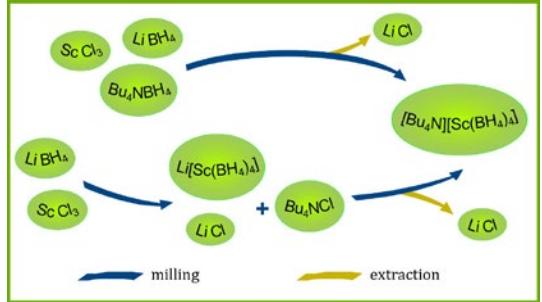
The prepared borohydrides were investigated with a number of methods, including IR spectroscopy (FTIR), powder X-ray diffraction (PXD) and thermal analysis (TGA/DSC) [2]. They also served as precursors towards the lithium- scandium borohydride in solvent-mediated reactions [3,4], e.g.:
$$ (Bu_4N)[Sc(BH_4)_4] + Li[An] \rightarrow Li[Sc(BH_4)_4] \downarrow + (Bu_4N)[An] $$where [An] is a weakly-coordinating anion, e.g. [Al(OC(CF3)3)4] or [B(3,5-(CF3)2C6H3)4]. In this case Li[Sc(BH4)4] is obtained as a LiCl-free product, in contrast to the earlier attempts [5]. The so-obtained Li[Sc(BH4)4] was decomposed at elevated temperature (400-800°C) in the inert gas atmosphere. The identification and characterization of solid state decomposition products were carried out on the base of FTIR, PXD, TGA/DSC, evolved gas analysis (EGA), X-ray photoelectron spectroscopy (XPS) and magnetic measurements (SQUID).
The described results of the research are the major part of the first author's master's thesis which will be defended in June 2015, which is carried out under supervision of two senior scientists.