
Using a single pulse of a tightly focused femtosecond laser, the modification without ablation of plastic and highly elastic metals is available with the formation of superficial nanostructures. The stresses induced by a high-intensity pulse produce a momentum normal to the metal surface leading to the delamination of a thin film and the formation of protrusions. The fast heating or even melting of the metal layer and fast resolidification of it lead to energy-dependent morphological shapes of the structures – bumps cones or jets [1].
The periodic arrays of such nanostructures excite hybrid lattice plasmon polariton exhibiting intense and practically applicable plasmon resonance. The narrow peak excitation is due to the interaction of diffracted light with surface lattice plasmons arising from periodically excited localized plasmons in each nanostructure [2]. The periodic gratings can be applied as refractive index sensors, perfect light absorbers, nanolasers, or in Raman spectroscopy [3].
The formation process, size, and shape of the nanostructures depend not only on the pulse energy but also on the laser wavelength. Using the direct laser writing method, the wavelength dependence was investigated by fabricating structures of different morphology using the first (1030 nm), second (515 nm), and third (343 nm) femtosecond laser harmonic. The bump structures remain quite similar, while the cone and jet morphology change significantly. The most prominent difference is seen in the jets (Fig. 1), as the ones fabricated with IR radiation are small and have a thick protrusion, while the ones manufactured with lower wavelengths have a thinner and pointier antenna. Also, using 1030 nm the influence of the polarization on the structure shape symmetry is observed.
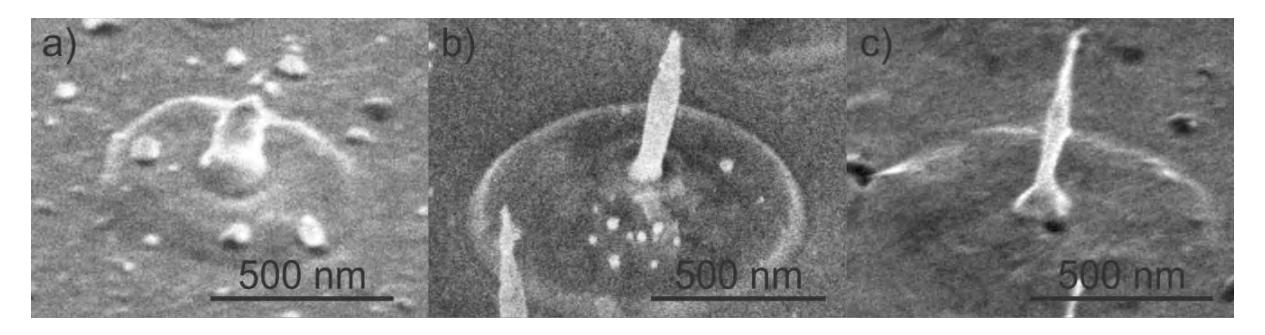
Furthermore, the laser wavelength influence on the achievable grating period and the nanostructure formation fluence was investigated. Both of these parameters decrease by implementing higher harmonics with shorter wavelengths, leading to a more precise formation of the nanostructures. Also, the thin film stress-induced intrinsic modifications similar to material fatigue were observed as the formation fluence required to obtain specific morphology decreased with higher pulse overlapping at smaller periods.
Finally, the periodic arrays of nanobumps were fabricated using different harmonics and the reflectance spectra were investigated using a spectrophotometer. All gratings exhibit high-quality resonances (Q-factor up to 40) with a marginal influence of the laser wavelength.