An episodic cycle of feeding and feedback (FB) seems to connects large galactic scales to the many orders of magnitude smaller supermassive black hole (SMBH) scales [1]. The ever-increasing amount of observations concerning the interplay between the infalling/outflowing ISM requires increasingly realistic and complex implementations of FB in numerical simulations.
A number of FB injection methods are currently available for use specifically in Smoothed-particle hydrodynamics simulations, which have their advantages and disadvantages. The simplest, spherical energy injection [2], distributes energy over a number of gas particles closest to the SMBH particle, ostensibly isotropically. While effective in many cases, this quick and dirty method is less successful when the small-scale structures in the proximity of the SMBH are of interest or the distribution of said matter is highly nonspherical [3]. On the other end, the virtual particle-based approach [4] allows for a more complex and flexible distribution of FB but is computationally very expensive.
we propose a new method that combines the flexibility of the virtual particle method while having a much lower computational cost. We define a spherical grid on which we propagate accretion disc wind at constant speed $v_{\text{wind}} \approx 0.1c$. Any particle that makes contact with the wind gets a portion of its energy/momentum or other stored quantity proportional to its contribution to the density field in that portion of the grid. Using our approach we are able to vary wind parameters over time and in different directions, for example to follow the variation of the accretion disc plane or to distribute FB in a conical shape.
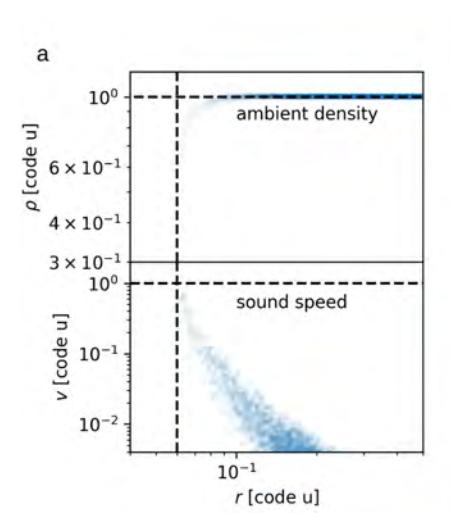
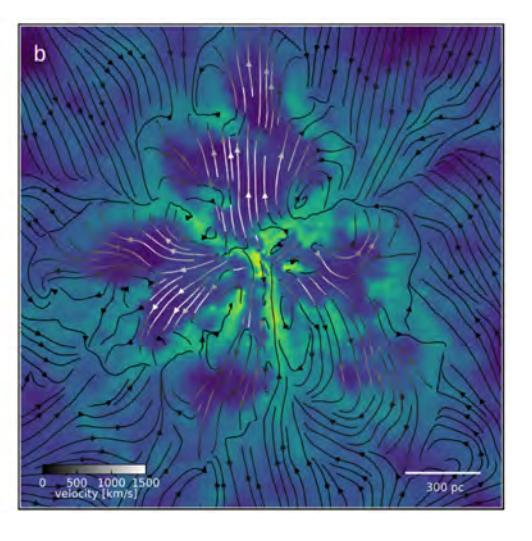
Currently, the method is implemented in Gadget-3 [5]. Our method compares well to the virtual particle-based approach in test cases (examples in Fig. 1). These are promising results, as our approach produces similar and consistent outcomes at only a fraction of the computation time (about 10 times faster in our current tests).