The motion of a resonantly driven particle in a quantum well can be interpreted as that of a particle in a crystal-like structure, with the time playing the role of a synthetic dimension [1]. Such an analogy lends itself to the introduction of the notion of time crystals, originally proposed by Wilczek in the context of spontaneous breaking of time-translation symmetry [2]. Time crystals provide a convenient platform for studying condensed matter phenomena, which have been reproduced in the temporal dimension both theoretically and experimentally [3]. Another possibility opened up by such an approach is that of constructing and studying high-dimensional physical system. This has been considered recently [4] by engineering a time-space crystalline structure, resulting in an up to six-dimensional system.
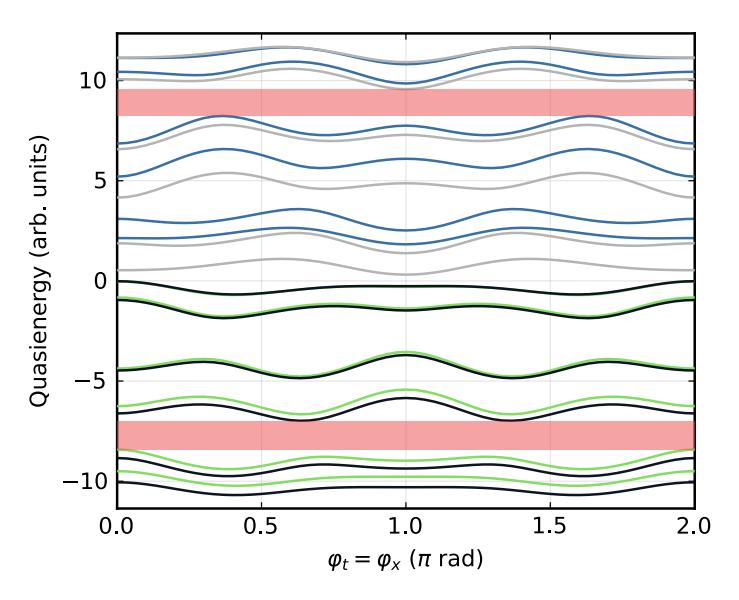
In the present work, we study topological pumping of particles [5] in systems of two to six dimensions, constructed based on time-space crystals. To this end we change the sinusoidal spatial potential considered previously [6] to a Dirac comb with modulated on-site energies. Starting with a system of a single spatial dimension, we analyse simultaneous pumping in time and space and obtain a gapped quasienergy spectrum (see Fig. 1). The second Chern numbers associated with the gaps are non-vanishing, indicating the topological nature of the pumping [7]. Considering one or two more spatial dimensions results in a four- or six-dimensional time-space crystalline structures, whose quasienergy spectra may remain gapped if parameters are chosen suitably.
To demonstrate the potential usefulness of the obtained results, we cast the spatio-temporal description of the system to an equivalent but conceptually simpler tight-binding form representing hopping of particles in a high-dimensional lattice. This shows that high-dimensional systems that can be conveniently described by a tight-binding Hamiltonian may be realised experimentally with the help of time-space crystalline structures.