
Oaks (Quercus) are widely distributed trees throughout the Northern Hemisphere, including Lithuania. These trees have a special fruit – acorns. The phytochemical potential, nutritional value, and biological activity of oak acorns are promising approaches in the management and treatment of various diseases [1]. There are naturally growing oaks and introduced oak species in Lithuania. Knowing that the common oak (Quercus robur L.) is a naturally growing oak in Lithuania, its fruits were selected for research. Furthermore, the fruits of red oak (Quercus rubra L.) were selected simultaneously because it is well adapted and widely introduced oak species in Lithuania.
Scientific literature [2] shows that all Quercus spp. acorns accumulate phytochemical compounds (phenolic compounds, volatile organic compounds, tocopherols, sterols, aliphatic alcohols, and fatty acids) that determine antioxidant and antibacterial properties. It is believable that the solvents of acorn extracts could significantly affect their biological activity [3]. Therefore, it is necessary to find the most optimal solvent, which would allow to extract the largest amounts of biologically active compounds and at the same time would be the most economical. For this reason, solvents such as bidistilled water (ddH2O), methanol (MeOH), and ethyl acetate (EtOAc) were chosen to investigate. Stepwise extraction is also evaluated additionally. Total phenolic compounds and flavonoid content were evaluated in prepared extracts by spectrophotometric tests [4].
The study showed that the antioxidant properties of acorns depended on the species of oak and sample extraction method (Fig. 1). During the first extraction step, the MeOH solvent showed significantly (p ≤0.05) higher amount of phenolic compounds compared to EtOAc. During the second step, it can be seen from the results that both ddH2O and MeOH had better properties to extract biological amounts of phenolic compounds (Fig. 1). This may be because many biologically active compounds remain after the first step extraction, and both the second and third extractions from the same raw material allow the extraction of large amounts of biologically active compounds. The same trend is repeated in the extracts of the third step extraction. The amount of flavonoids in acorns (range from 0.23 to 3.42 mg/g) is significantly lower than that of phenolic compounds (range from 0.92 mg/g to 45.42 mg/g). The EtOAc-MeOH-ddH2O extraction sequence was found to extract the highest amounts of total phenolics and flavonoids from both oak acorns (120.23 mg/g).
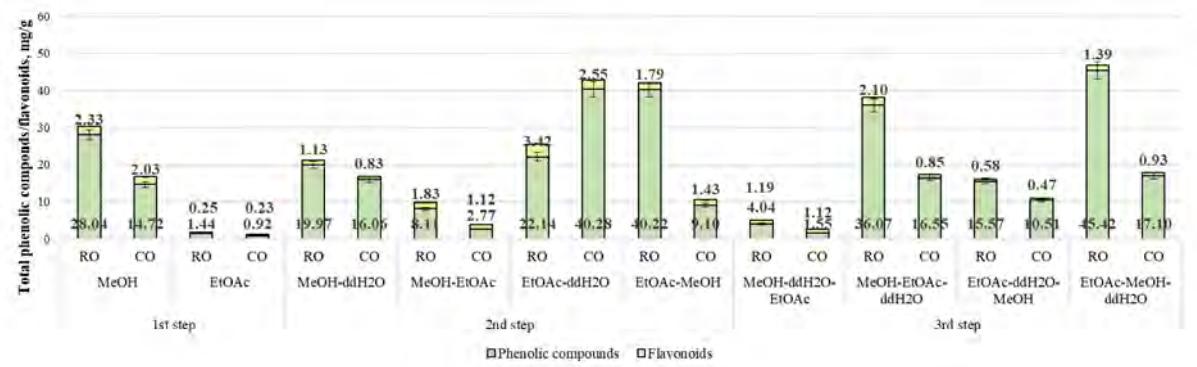
In the assessment of the amounts of bioactive compounds in different solvents and extraction methods, it can be stated that the methods used affected the amounts of phytochemical compounds, which can result in increased antioxidant activity. It is likely that the proper solvent and extraction conditions can be used to further enhance phytochemical levels in acorns.