Calcium phosphates (CaPs) are a versatile family of materials most widely used as bone graft substitutes and for targeted drug delivery in biomedical fields [1], in creation of sensors for direct detection of phosphate in aqueous solutions [2], in water purification for heavy metals [3], etc. CaPs are known for their biocompatibility, they are also easily and inexpensively produced, are safe, and can be relatively easily certified for clinical use. In the medical field, calcium orthophosphates such as hydroxyapatite (HA, Ca10(PO4)6(OH)2), tricalcium phosphate (TCP, Ca3(PO4)2), and amorphous calcium phosphate (ACP) are frequently utilized. Recent studies on biomaterials showed the potential of the use of calcium pyrophosphate (CPP, Ca2P2O7) for biomedical applications [4]. We studied α-CPP, β-CPP and γ-CPP polymorphs.
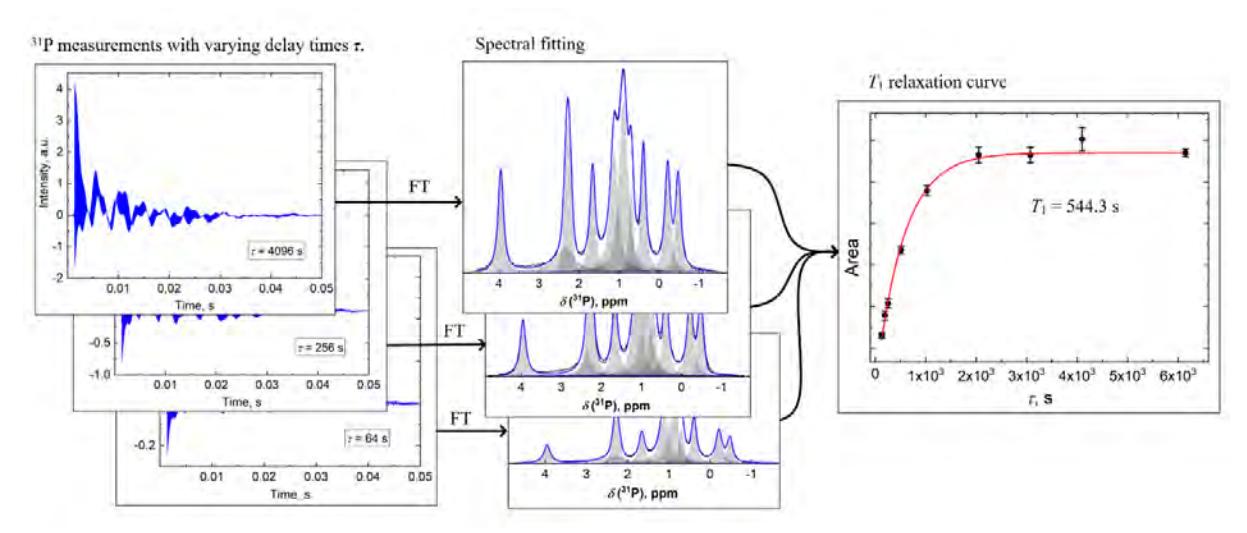
Fig. 1. Visualized procedure of the T1 relaxation measurement. Left – acquired free induction decays (FID) of the samples. Middle – after Fourier transform (FT) peaks were approximated by theoretical curves. Right - first peak's (3.95 ppm) T1 relaxation curve and fitting by using Eq. (1) approximation.
To study CPPs, solid-state nuclear magnetic resonance (NMR) was used. Spin-lattice (T1) relaxation times were measured using the saturation recovery method. Radiation-exposed CPP samples showed reduced relaxation times. For overlapping peaks spectral fitting using Gauss, Lorenz or Voigt theoretical spectral lines were performed. The overlapping peaks positions were referenced from [5] article. By examining the dependence of relaxation time by exposure time, the structural integrity of CPP polymorphs was evaluated.
[1] Habraken, W., Habibovic, P., Epple, M. & Bohner, M. Calcium phosphates in biomedical applications: Materials for the future? Mater. Today19, 69–87.
[2] Sun, S., Chen, Q., Sheth, S., Ran, G. & Song, Q. Direct electrochemical sensing of phosphate in aqueous solutions based on phase transition of calcium phosphate. ACS Sensors5, 541–548.
[3] Goto, T. & Sasaki, K. Synthesis of morphologically controlled hydroxyapatite from fsh bone by urea-assisted hydrothermal treatment and its Sr2+ sorption capacity. Powder Technol.292, 314–322.
[4] Kaido Kurrikoff, Birgit Vunk, Ülo Langel. (2021) Status update in the use of cell-penetrating peptides for the delivery of macromolecular therapeutics. Expert Opinion on Biological Therapy21:3, pages 361-370.
[5] Griesiute, D., Garskaite, E., Antuzevics, A. et al. Synthesis, structural and luminescent properties of Mn-doped calcium pyrophosphate (Ca2P2O7) polymorphs. Sci Rep12, 7116 (2022).