
Materials with structural hierarchy gained increasing interest in various fields due to their unique and tunable properties. Hierarchically constructed multi-level systems are characterized by a multi-scale organization which can be achieved by assembling nano- and microparticles together in a well-defined manner.
The main advantage of multi-level particles is the ability to integrate multiple components with specific functions into a single system. Additionally, several analytical methods can be combined with great specificity and accuracy. The formation of five-level hierarchical core-shell particles was a model experiment, however, these particles have a great potential for a wide range of applications, including selective sensing, particle-based SERS sensing, catalysis, filtration, as well as various fields in biomedicine and material science.
One of the most important factors for forming multi-level composite particles is controlled assembly of different materials. The controlled assembly needs to be ensured at different levels of organization. In previous works [1,2] the construction principles of a hierarchically structured three and four-level systems were presented in detail. The good reproducibility of the presented four-level composite system allowed the modification of several formation steps in order to increase structural hierarchy. In this way, highly structured five-level systems were formed in a multi-step process. A schematic representation of the design of core-shell composite particles is shown in Fig. 1.
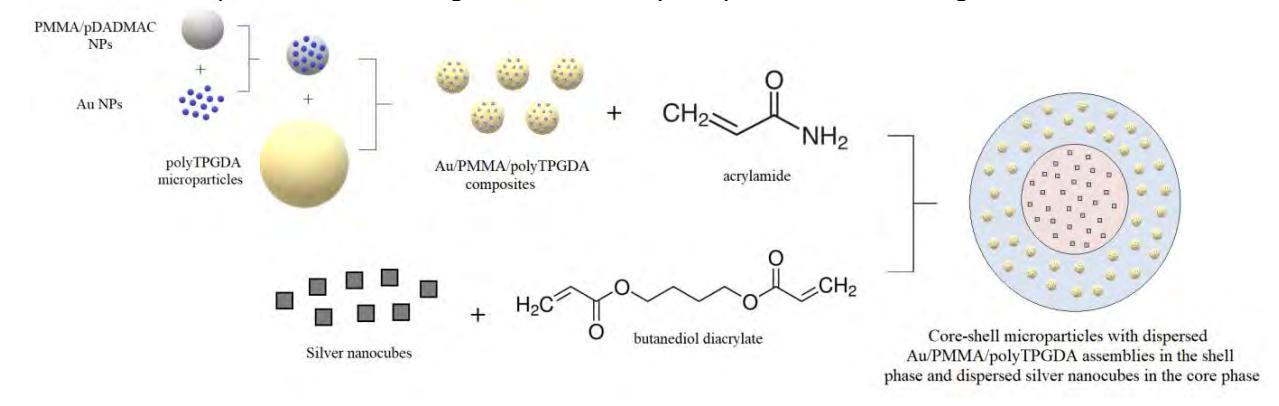
First, metal (Au, Ag) and polymer (PMMA, poly-TPGDA) nano- and microparticles were synthesized as individual building blocks. After, Au nanoparticles were electrostatically attached to the surface of PMMA nanoparticles and the Au/PMMA composites were formed. Prepared Au/PMMA composites were mixed with poly-TPGDA microparticles in a batch reaction and incubated at room temperature for 24 h. During incubation time, Au/PMMA composites attached to the microparticle surface and due to electrostatic attraction hierarchically structured Au/PMMA/poly-TPGDA composites were successfully formed. In the next step, core and shell monomer phases were prepared. The Au/PMMA/poly-TPGDA composites were dispersed in the shell monomer phase and Ag nanocubes were dispersed in the core phase. The synthesis of core-shell microparticles containing nested sets of dispersed metal and polymer micro- and nanoparticles was achieved through in-situ photopolymerization using a two-co-axial capillary microfluidic device.
The process was optimized by controlling the flow rates of the carrier, shell, and core phases, with the results revealing that an increase in carrier flow rate reduced particle size, while an increase in shell and core flow rate increased particle size. Also, it has been proven that in-situ photopolymerized core-shell composite particles are robust, permeable, and potentially applicable for particle-based sensing, for example for SERS applications.