
The efficiency of conversion of light energy into electrical energy of photovoltaic (PV) panels decreases with time. Efficiency is susceptible to defects originating from various factors related to solar cell and/or PV panel manufacturing or handling/shipping, as well as PV panel inaccurate installation processes or extreme weather conditions that can limit not only conversion efficiency but also can cause early device failure. Physical defects such as broken front glass, cells' cracked cells, busbar contact defects, missing or broken snail trails, cracked back-sheets of panels etc. have a prominent impact on long-term PV panel efficiency. [1]
The defects that are invisible to the human eye (i.e., microcracks, soldering defects, p-n junction failure etc.) detects electroluminescence (EL) control system, which makes the current distribution in the panel visible and helps to identify defect location in the panel. [2] Electroluminescence is a process of electrical power conversion into light that leads to the generation of photons as a result of the radiative recombination of holes and electrons during the passage of an electric current through a material. This system consists of a source of electrical current to power a solar panel and a CCD camera to capture the light emitted by the panel in response to the passage of an electrical current. A captured image is analysed by a software which compares the contrast in different places of captured image (Fig. 1).
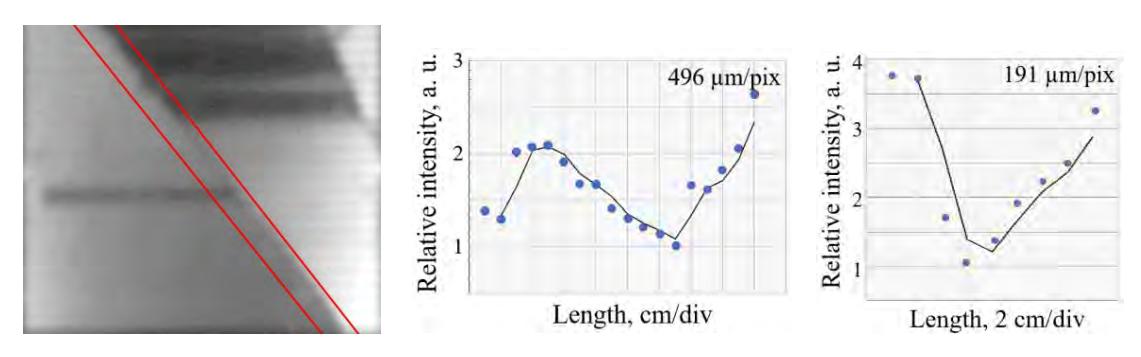
The resolution limit of the contrast depends on the distance between the CCD camera and the PV panel as well as the quality of the image captured by the CCD camera. Current work proposes a new approach for increasing a resolution limit of the EL system by means of moving the object closer to the CCD camera and in such a way increasing the resolution of captured image. By increasing the resolution of the EL control system and quality of the captured image, one can more accurately determine the type of observed defects and guess the origin of these defects appearance in the solar cell/panel, the potential of expansion of observed defected area with time depending on ambient temperature and humidity variations, and the defect effect on efficiency of light conversion into electrical energy and lifetime of the entire solar cell or PV module operating in a power plant.