Calcium phosphates (CPs) are the family of materials, widely used in different areas such as medicine and bone regeneration, catalysis, sensors, removal of heavy metals from water, as host matrices for the development of optical materials, etc. CPs can be classified by many parameters including crystal structure, Ca-to-P ratio, presence of other structural species (e.g. OH-, CO32-, Cl-, F-). Compositional and structural variety of CPs leads to their different chemical and physical properties. Some CPs can be easily synthesized by direct precipitation from aqueous solutions or solid state reaction. Another approach for the synthesis of CPs considers phase transformation of less stable CPs under specific conditions. [1], [2]
The remarkable member of this family is amorphous calcium phosphate (ACP), which possesses a number of features making it a very special material. Due to the absence of crystalline ordering ACP exhibits very high solubility and reactivity. Moreover, unlike the most crystalline CPs, where Ca-to-P ratio is well-defined, in ACP this ratio can vary in a relatively broad range from 1.2 to 2.2. ACPs can be used as precursors for the preparation of crystalline materials. Phase conversion of ACP to other crystalline CPs can be induced in different ways. In aqueous medium ACP rapidly transforms to apatite-like crystalline material. Another approach is the crystallization of ACP induced by thermal treatment at elevated temperatures. ACP with the Ca-to-P ratio 1.5:1 upon calcination transforms to tricalcium phosphate (TCP, Ca3(PO4)2). This material cannot be precipitated directly from aqueous solution under artificial or physiological conditions, it can be synthesized only through the thermal treatment of other CPs. The α-TCP prepared in such a manner is also called metastable α-TCP, upon heating it transforms to β-TCP at around 950 °C and again to α-TCP at around 1125 °C.[3]
In the present work, we demonstrate the phase transformations of ACP in molten chlorides. LiCl, NaCl, KCl, CaCl2 and their mixtures were mixed with initial ACP and annealed above their melting point. The obtained results revealed that ACP reacts with molten chlorides resulting in the formation of chlorinated CPs. Under certain conditions ACP can be converted to calcium chlorapatite (Ca5(PO4)3Cl) or CaPO4Cl. The influence of synthesis conditions such as annealing temperature, time, flux composition and ACP-to-chlorides ratio was investigated in detail.
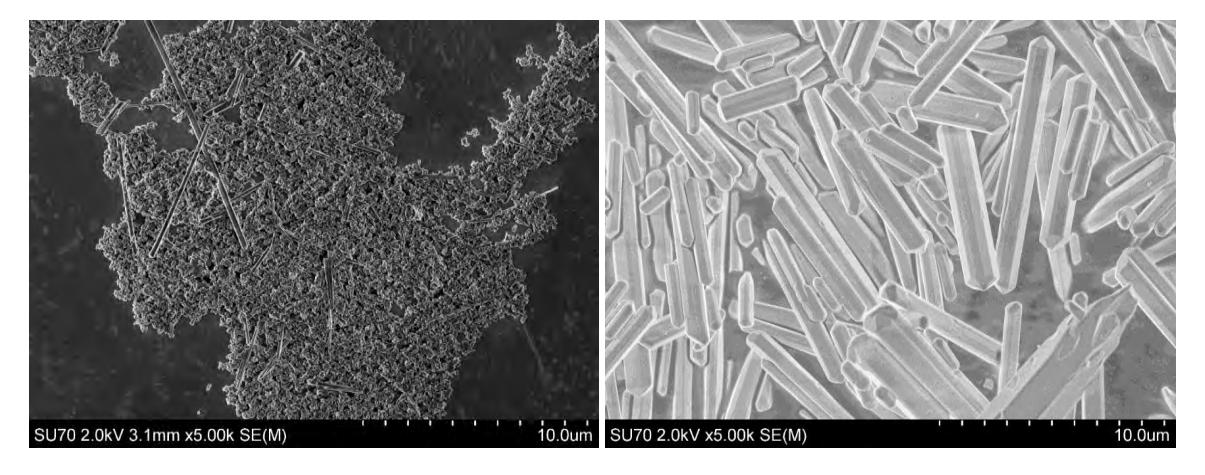
The phase purity, crystal structure and structural changes were evaluated by powder X-ray diffraction (XRD), Fourier-transform infrared (FTIR) spectroscopy. Scanning electron microscopy (SEM) was used for the characterization of morphological features of products.