Currently, white light-emitting diodes (w-LEDs) are mainly manufactured by coating yellow-emitting YAG:Ce3+ phosphors on the blue-emitting InGaN chips. However, this LED due to the lack of red-emitting component exhibits the high correlated color temperature (CCT) and low color rendering index (CRI) [1]. To overcome these drawbacks, there is a need to find a stable, inorganic rare-earth based phosphor with high luminescence efficiency.
Sodium aluminum germanate NaAlGeO4 has the calcium ferrite structure with space group Pnma and having cell parameters a=8.87, b=2.84, c=10.40 Å and Dx=4.73 g/cm3 [2]. Recently, germanate compounds have been paid more and more attention because of low synthesized temperature and excellent physical/chemical properties. Some germanate-based phosphors with excellent luminescence performance for different practical applications have been developed such as K2SrGe8O18:Eu3+[3], CaZnGe2O6:Bi3+[4] and CaMgGe2O6:Mn2+,Sm3+ [5,6]. LiYGeO4:Bi3+[7] is known as persistent luminescent material that can luminescent for hours after removing the excitation source. In this study, NaAlGeO4 phosphors doped with Eu3+, Dy3+ and Bi3+ can be expected for LEDs application.
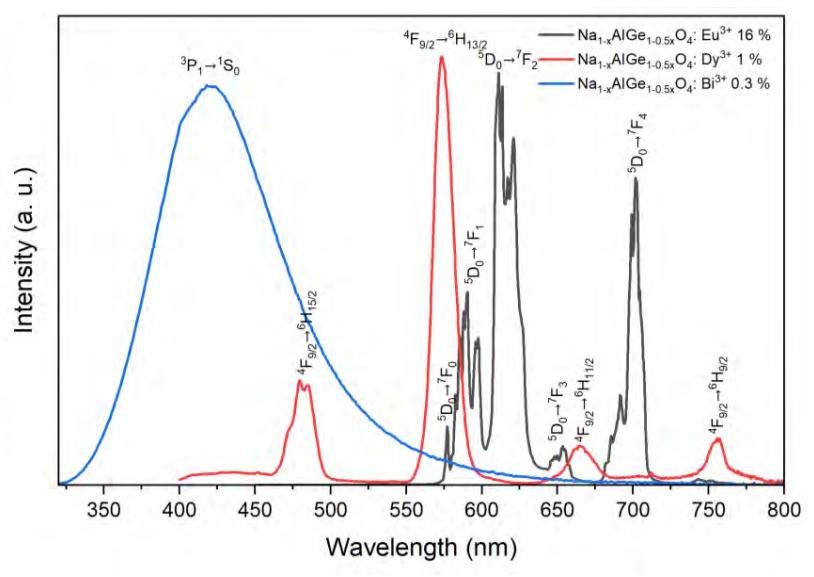
During this work, a series of NaAlGeO4 activated with the different concentration of trivalent Eu, Dy and Bi ions were synthesized using solid-state synthesis method. Obtained samples were characterized by powder X-ray diffraction (XRD) method and photoluminescence (PL) measurements such as excitation and emission spectra, luminescence decay times and quantum efficiencies. XRD analysis revealed that all the samples consist of pure NaAlGeO4 phase. From the PL measurements we found out, that Eu3+-doped samples exhibit red emission at 611 nm with highest intensity peak at 16% sample, while the longest luminescence decay was observed in the Na1-xAlGe1-0,5xO4:Eu 0.5% sample. The highest Dy3+ emission intensities were found to be at 573.5 nm in the Na1-xAlGe1-0,5xO4:Dy 1% sample and Bi3+-doped at 420 nm with the concentration of 0.3%.